Skip to content

Markdown optimization for enterprise retailers

Reduce excess inventory and protect gross margin with markdown optimization that works at the SKU level. Competera's Pricing Platform uses demand forecasting, elasticity modeling, and what-if simulations to help enterprise retailers plan, test, and execute markdown campaigns with 95%+ prediction accuracy.

Talk to expert
1st-Screen-image-(hero-image)

The cost of getting markdowns wrong

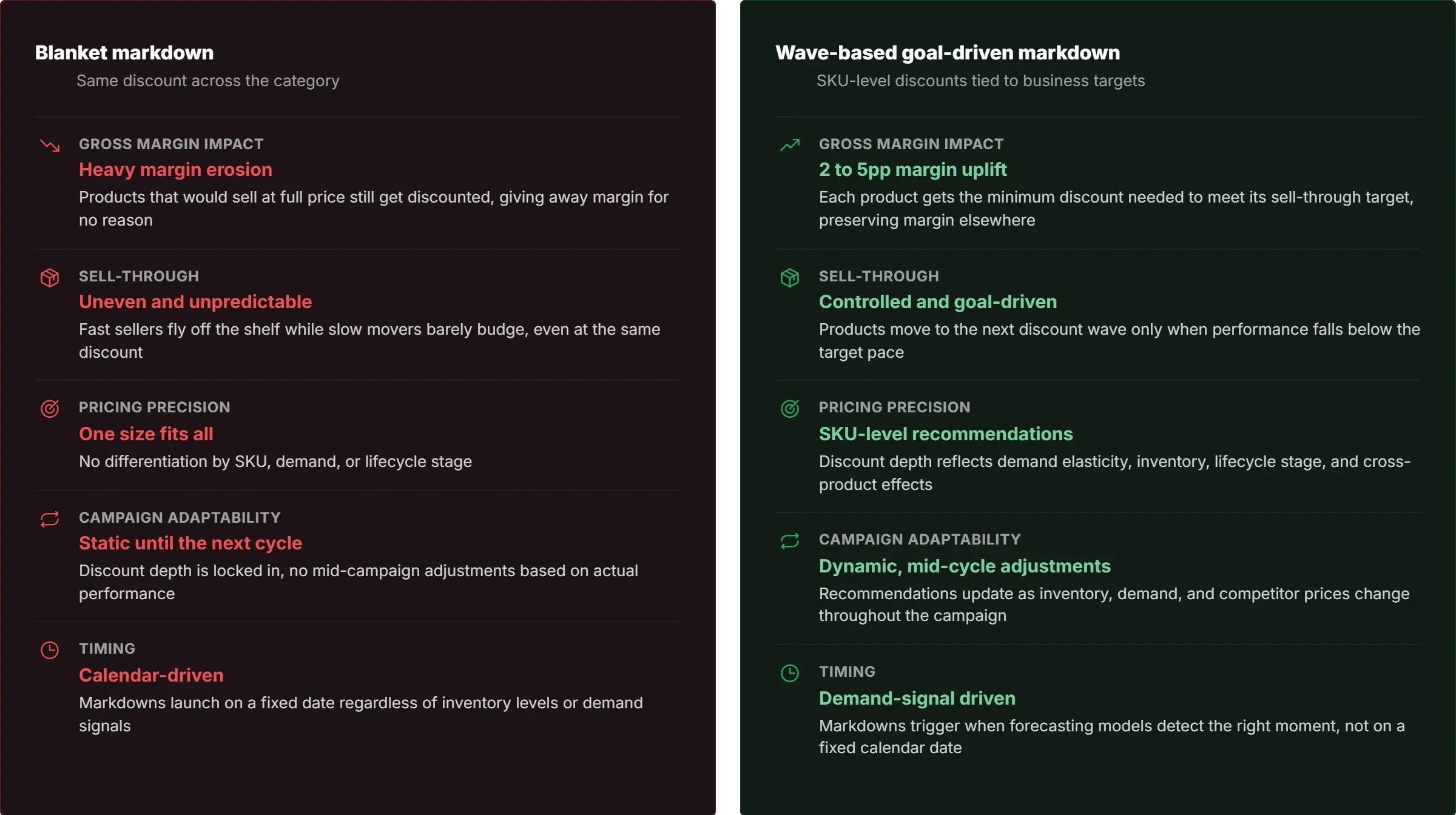
Blanket discounts are still widely applied across retail industries. They're easy to execute but the problem is that products rarely behave the same way. Some need deeper discounts to sell. Others don't need a markdown at all.

Markdown optimization replaces broad price cuts with SKU-level decisions. With advanced solutions integrating demand signals, inventory data, and business goals, retailers can reduce excess stock while protecting profitability.

blanket-markdown-vs-wave-based-infographic

What is markdown optimization?

Markdown optimization is the process of deciding when to discount a product, how much to reduce the price, and which products belong in each campaign.

It’s not about simply clearing inventory. It's about balancing sell-through, revenue, and margins.

Advanced markdown optimization in retail uses Artificial Intelligence (AI), demand forecasting, and demand elasticity to estimate how customers will respond. Using tech-savvy tools, pricing teams can evaluate different scenarios and launch campaigns based on real evidence.

Sell-through targets and discount waves

Rather than applying one large markdown, retailers usually introduce discounts in planned waves. Prices are reduced only when products fail to meet the expected sales pace.

A well-designed markdown pricing strategy gives every product the opportunity to sell at the highest possible price before moving to the next discount level.

With AI markdown optimization, those decisions happen at SKU level. Recommendations change as demand changes, helping retailers reach commercial targets without unnecessary markdowns.

The role of demand forecasting in markdown timing

Timing often determines whether a markdown succeeds. An inventory markdown launched too early reduces margin. Waiting too long results in aging stock that becomes even harder to sell.

That’s where demand forecasting comes into play. Fueled with high-quality market data, it helps predict customer response before a campaign begins. In combination with elasticity modeling executed by algorithms, it supports dynamic markdown pricing that adapts as inventory levels and demand change.

How markdown optimization works

Smart markdown optimization starts with a clear business goal. It can be clearing seasonal inventory, reducing overstocks, or maximizing margin.

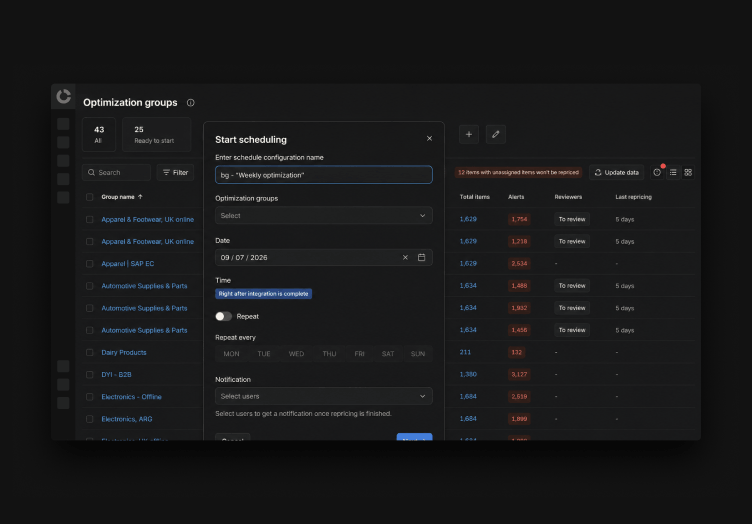
To generate the best discount for every SKU within each wave of markdown, Competera integrates demand forecasts, inventory levels, and customer behavior insights. While relying on fixed rules doesn’t bring the expected results, the platform predicts how different markdown scenarios will affect sell-through, revenue, and profit. All in a safe environment and before prices go live.

Retailers stay in control. They define the objectives and business constraints while the system recommends the timing, discount depth, and sequence of markdown waves.

Key challenges in retail markdown pricing

Simply put there are three major challenges associated with markdown price optimization. These are finding which products to discount, when to do it, and how far discounts should go.

Besides, manual markdown management fails. And when assortments grow, customer demand shifts, and sales happen across channels, it becomes almost impossible to do it without advanced tools. 

Blanket discounts that destroy margin

Some products will sell with a small price reduction, while others require a much deeper discount. Applying the same markdown across an entire category often means giving away margin where it isn't necessary.

A better markdown pricing strategy recommends discounts at SKU level, based on expected demand rather than broad assumptions.

No visibility into outcomes before execution

Many pricing teams don't know whether a markdown will work until the campaign is already running.

Without forecasts, every discount becomes an experiment. Revenue, margin, and sell-through can only be measured after prices change.

Predictive models remove much of that uncertainty. Teams can compare different scenarios before launch and choose the one that best supports their business goals.

Markdown campaigns that can't adapt mid-cycle

Markets don't stand still. Inventory changes. Competitors adjust prices. Customer demand shifts throughout the season.

Static markdown calendars can't react quickly enough. Dynamic markdown pricing keeps recommendations up to date, allowing retailers to adjust campaigns as conditions change instead of waiting for the next pricing cycle.

Markdown isolated from the rest of pricing

Markdowns shouldn't operate separately from everyday pricing or promotions.

When different pricing clusters are merged separately, they may start work against each other. Promotions undermine markdowns, price positioning is compromised, and profitability suffers.

Scaling markdowns across channels and markets

Managing a few hundred products manually is possible. But when it comes to tens of thousands of SKUs across stores, geographies, and channels, manual practices may lead to unprecedented money leakages.

This is why enterprise retailers need markdown optimization software capable of automatically adapting markdown campaigns to each channel and market. 

Competera

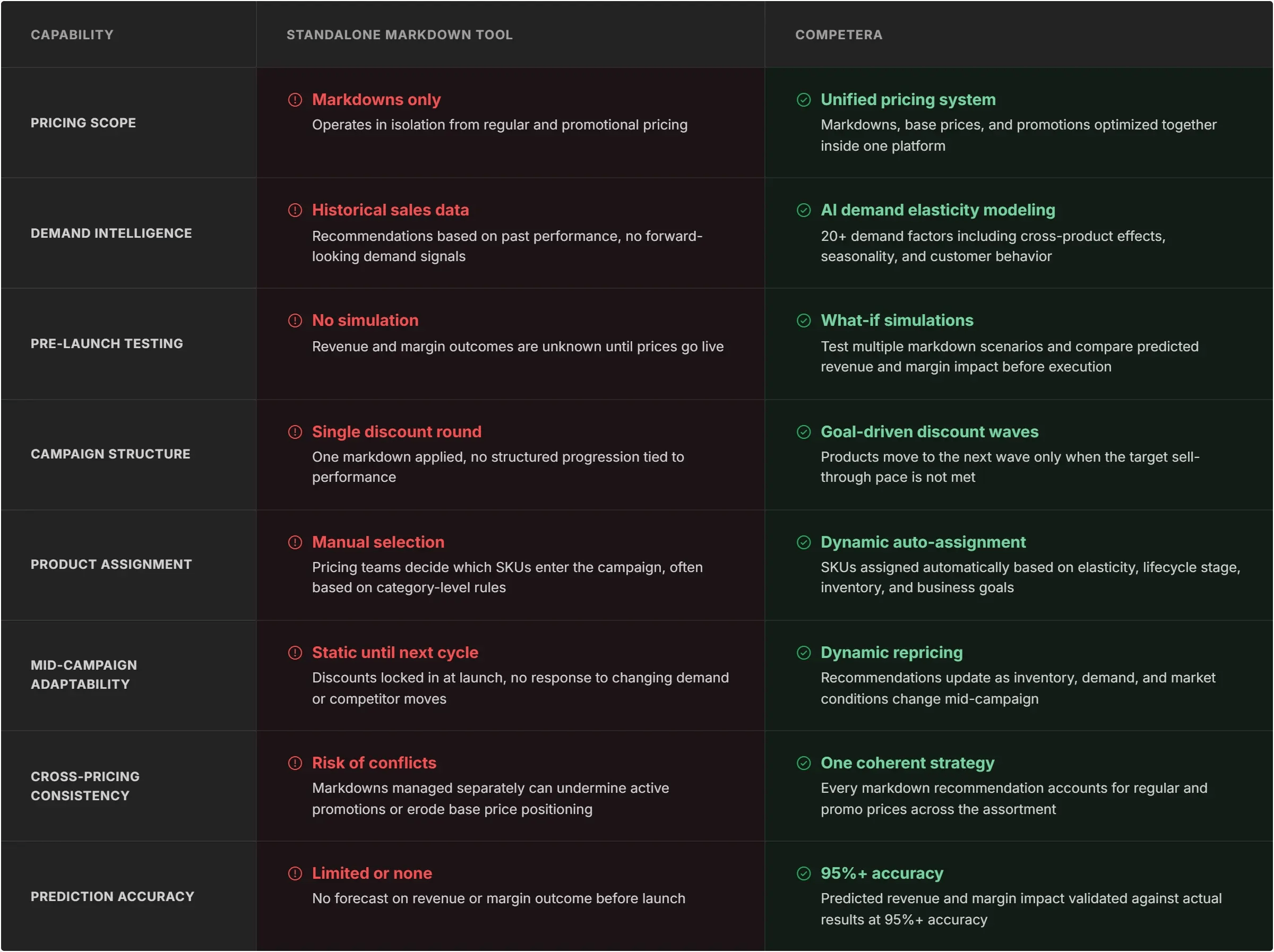
Why standalone markdown optimization software solutions fall short

Many markdown optimization software solutions focus on one task: recommending discounts.

The problem is that markdowns don't exist in isolation. They directly impact the effectiveness of regular prices, promo campaigns, and inventory management.

Competera takes a holistic approach. Markdowns, promotions, and base prices work together inside one pricing system, giving retailers a consistent strategy across every channel.

standalone-markdown-tool-vs-competera-table

Markdown optimization use cases

Markdown strategies may vary depending on SKU type. A tech-driven approach to markdown price optimization helps retailers reduce excess inventory without discounting more than necessary.
Use-case-1-End-of-season-clearance

End-of-season clearance

The struggle of end-of-season clearance implies protecting as much margin as possible. Markdown optimization introduces discounts in planned waves instead of applying the deepest markdown from day one. Products that continue selling stay at higher prices, while slower-moving items receive additional reductions only when needed.

Use-case-2-Lifecycle-triggered-markdowns

Lifecycle-triggered markdowns

Every product follows a lifecycle. Pricing should follow it too. With markdown optimization in retail, discounts are triggered by product performance and lifecycle stage rather than fixed calendar dates. Retailers can react sooner to slow-moving products and delay markdowns for items that continue to sell at full price.

Use-case-3-Overstock-reduction-1

Overstock reduction

Rather than discounting an entire category, inventory markdown strategies focus on the products that actually need price adjustments. This resolves the overstock issue while preserving margin across the rest of the assortment.

How Competera's markdown optimization works

Competera’s approach to markdown management is based on integrating demand forecasting, price elasticity modeling, and smart business rules to optimize campaigns. Both at scale and across channels. Every price recommendation balances commercial goals with customer expectations, helping to increase sell-through without losing profitability.

Product-feature-1-Goal-driven-markdown-waves

Goal-driven markdown waves

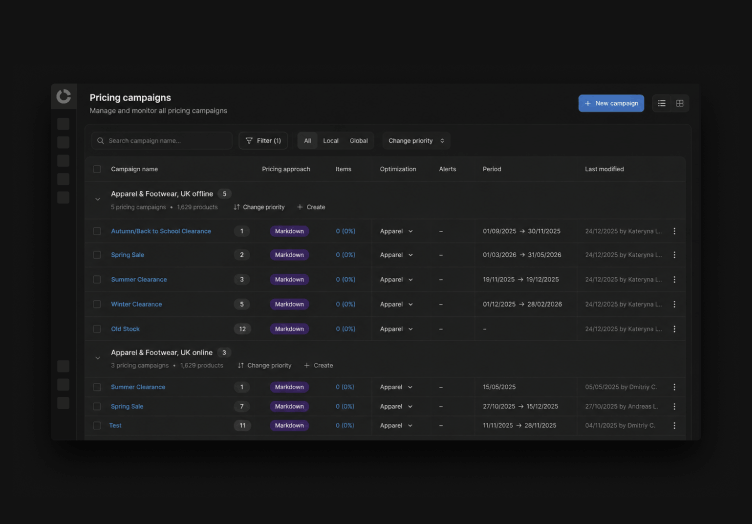
With Competera, retailers can transform markdown campaigns into planned waves tied to specific business goals. Simply put, products move to the next discount level only when the required performance indicator is reached.

Product-feature-2-What-if-simulation-before-execution

What-if simulation before execution

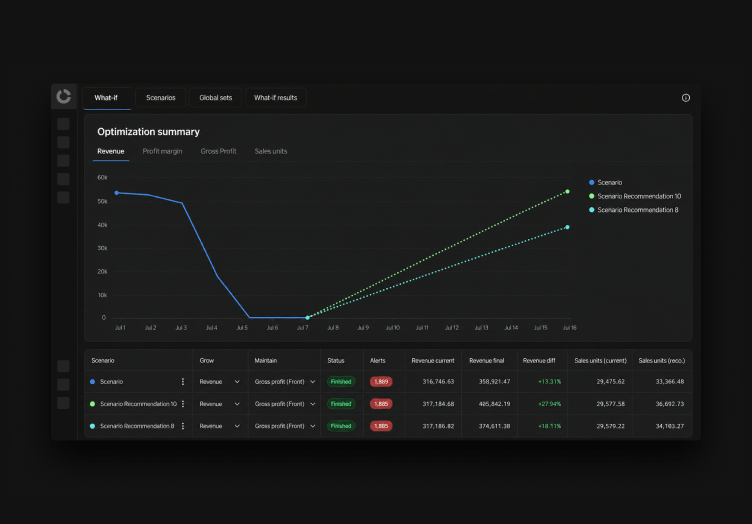
Every markdown affects revenue and margin differently. Competera allows testing multiple scenarios safely before a real campaign is launched. Teams can analyze and compare expected business outcomes and choose the best-fitting strategy.

Product-feature-3-Dynamic-product-assignment

Dynamic product assignment

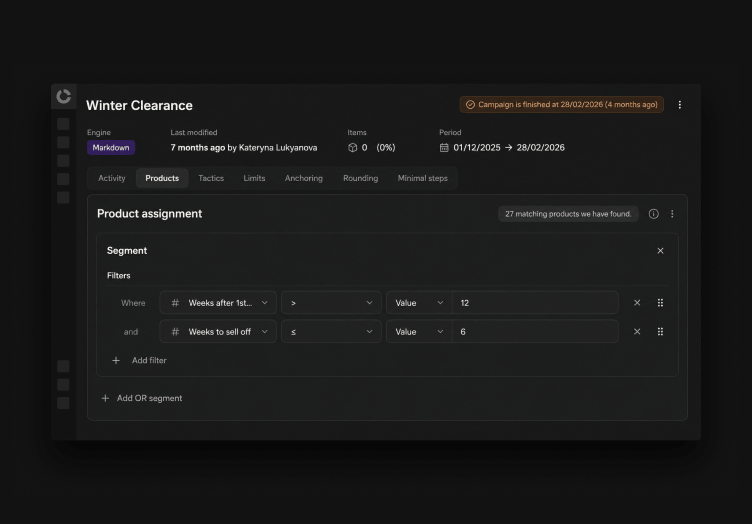
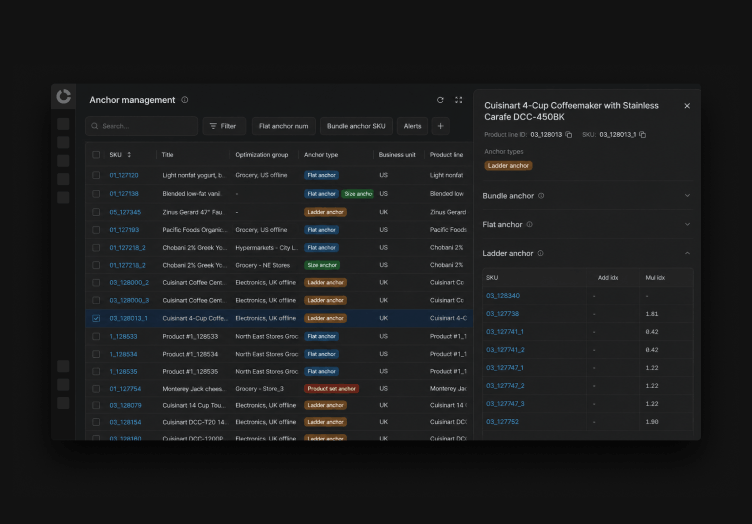
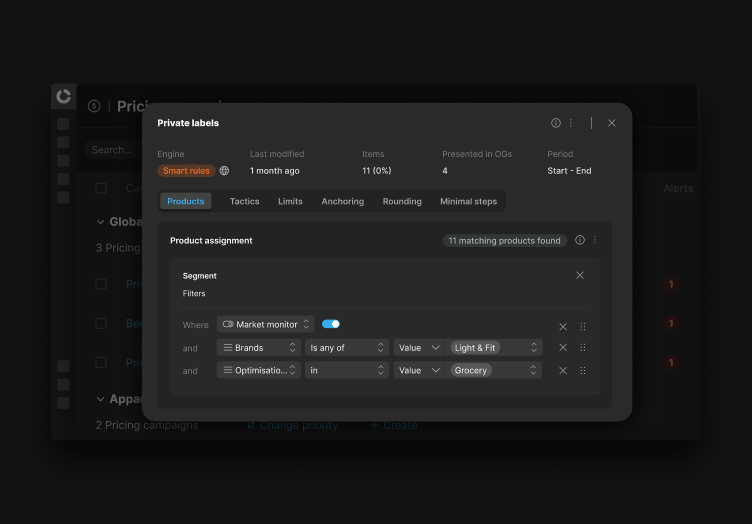
Competera automatically assigns SKUs to relevant markdown campaigns based on price elasticity, lifecycle stage, inventory level, past performance, and business goals. That means no manual work is required while each campaign is aligned to market conditions and pricing objectives.

Product-feature-4-AI-powered-demand-based-repricing

AI-powered demand-based repricing

Customer demand depends on much more than price. Competera models use elasticity, inventory, product relationships, and other demand drivers to generate SKU-level recommendations. This AI markdown optimization approach reflects how customers actually shop, not just how products performed historically.

Product-feature-5-Unified-with-base-and-promo-pricing

Unified with base and promo pricing

Markdowns are only one part of a pricing strategy. Competera optimizes markdowns alongside regular and promotional prices in a single platform. That creates more consistent pricing, eliminates conflicting decisions, and helps retailers make every price change work toward the same commercial goals.

Product-feature-6-Repricing-limits-and-margin-guardrails

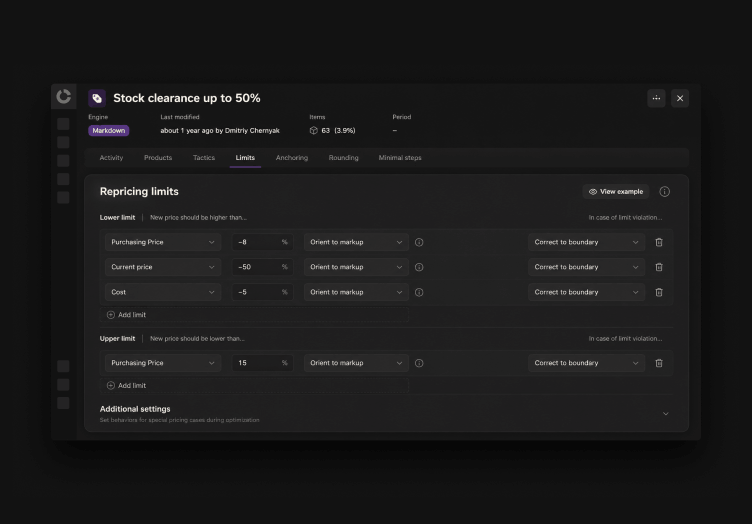
Repricing limits and margin guardrails

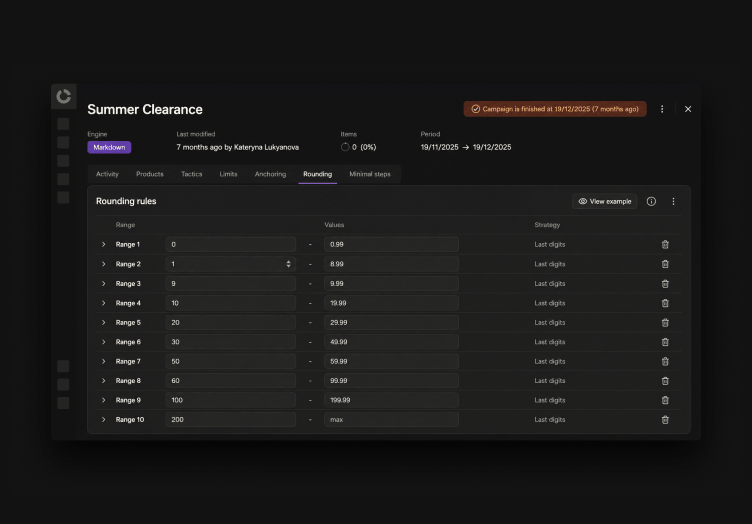
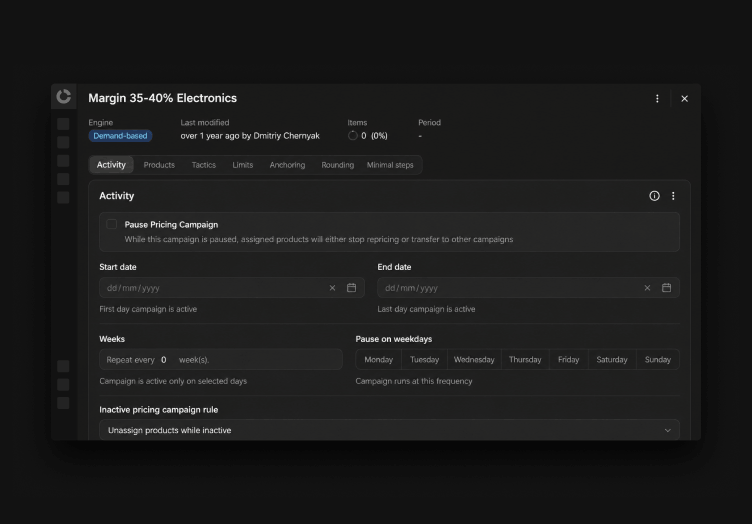
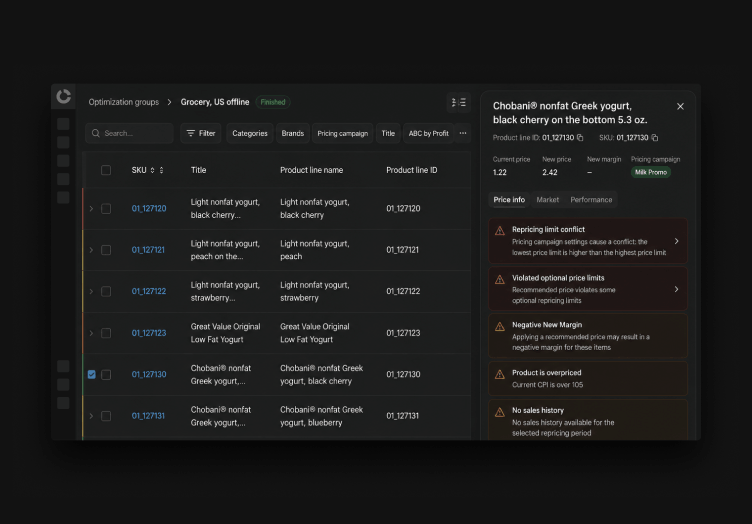
Automation should never mean losing control. Competera allows retailers to define price floors, minimum margins, and other business rules before optimization begins. Every recommendation stays within those limits.

What enterprise retailers achieve with Competera's markdown optimization

With Competera, markdowns become rather a measurable pricing capability, not just an end-of-season exercise. On average, our customers achieve:

  • 95%+ accuracy when predicting revenue and margin impact before prices go live

  • 2–5 percentage point gross margin uplift

  • 3–7% revenue growth

  • 50–70% less manual pricing work

  • New channels or regions optimized in as little as one week

Explore more solutions

Dynamic pricing software creates revenue opportunities across every pricing scenario.

Similar-solution-1-Dynamic-pricing-software

Dynamic pricing software

Optimize prices across your full assortment using demand elasticity modeling, competitive data, and business rules working together. Competera's AI-driven approach accounts for cross-product effects, seasonality, and customer behavior to recommend prices that grow revenue and protect margin at scale.

Similar-solution-2-Price-intelligence-software

Price intelligence software

Monitor competitor prices and market activity with high-quality competitive data covering 34 markets and 119M+ data points monthly. Get accurate product matching, promotional flags, and availability signals that give pricing teams the context they need to act with confidence.

Similar-solution-3-Pricing-analytics-software

Pricing analytics software

Understand pricing performance with advanced analytics, demand forecasting, and custom reporting. Simulate the revenue and margin impact of pricing decisions before going live, and track results across categories, channels, and campaigns in one place.

FAQ

01

What is markdown optimization?

Retail markdown optimization is an integrated approach which helps teams decide when, how, and which SKUs to discount. The objectives may vary, yet, in most cases, retailers want to improve sell-through without compromising margins.
02

How is markdown optimization different from blanket discounting?

Blanket discounting implies applying the same discount for each product. Instead, markdown optimization recommends a unique discount for each SKU based on dozens or factors and parameters. 
03

How is Competera's markdown optimization different from standalone markdown tools?

Competera optimizes markdowns together with base and promotional pricing. That creates one pricing strategy across the assortment instead of managing markdowns in isolation.
04

Can markdown campaigns be automated?

Yes. Competera automates product assignment, discount recommendations, and campaign execution while allowing retailers to define business rules and pricing guardrails.

05

What sell-through goals can I set?

The typical goals include end-of-season clearance, hitting the stock level, reaching a particular turnover rate, or protecting margins.
06

Does markdown optimization work across multiple channels?

Yes. Competera delivers localized recommendations across stores, regions, and eCommerce channels while keeping pricing aligned with overall business objectives.
07

How does markdown optimization connect to regular pricing and promotions?

Markdowns are optimized alongside base and promotional prices, giving retailers one consistent pricing strategy across the entire assortment.
08

What role does demand forecasting play in markdown optimization?

Demand forecasting is used by retailers to predict how consumers will respond to a price change. Based on demand forecasting results, timing and discount depths are defined.
09

How long does it take to get started with markdown campaigns in Competera?

Typically pricing optimization to a new sales channel or region takes one week. However, the exact timing depends on portfolio scale and retailer profile. 

Start optimizing markdowns with confidence

Set the right price for every product, reduce unnecessary discounts, and achieve your sell-through goals with Competera.
TALK TO AN EXPERT
Price recommendation banner