
Skip to content

AI pricing analytics software for enterprise retailers

Discover how AI pricing analytics software empowers enterprise retailers with  the demand intelligence and simulation capabilities required to make more efficient pricing decisions faster. Learn how Competera combines pricing insight with execution across every single category, channel, and store.

Talk to expert
1st-Screen-image-(hero-image)
Trusted by 50+ organizations across the globe
CapterraG2Crozdesk
Findel LogoCultbeaut LogoLookfantastic LogoNovus LogoStarboard LogoFlaconi LogoSephora LogoJumia LogoUnioncoop LogoWilko LogoAutodoc LogoRange LogoLyreco Logo

Why enterprise retailers can no longer price without analytics

Most enterprise pricing teams have an abundance of data to work with: sales history, competitor feeds, cost inputs, and category reports. What they don’t have is a reliable answer to the single most important question: Given the current market conditions, what should be the cost of this product?

Pricing decisions without analytics have to rely on rules, intuition, and lagging reports. This includes setting the prices based on what was successful in the previous quarter, modifying those prices manually if something looks incorrect, and only reviewing the pricing situation once the damage is already done.

As the size of enterprise retailers’ catalogs grows, so does the cost of each pricing error. A mispriced SKU in a small inventory list is, at worst, a rounding error. A mispriced category across hundreds of stores costs tens of thousands in lost revenue and compounds daily.

What is pricing analytics software?

A pricing analytics software is a platform responsible for collecting, modeling, and interpreting pricing-relevant information for the purpose of enabling better pricing decisions. It can be a tool for monitoring price performance across products and channels as a baseline. At its most efficient, this software models demand elasticity, simulates the revenue and margin impact of price changes before they are made, and offers AI-powered recommendations along with the reasoning behind each of them.

The distinction between pricing analytics and pricing intelligence is important enough to worth mentioning:

  • Pricing intelligence is mostly about competitive monitoring: analyzing the price points of competitors and comparing them to a company’s own prices to answer the question "what is happening in the market right now?"

  • Pricing analytics is more advanced in comparison, attempting to answer what a price change would do to demand, how it’ll interact with other products in the portfolio, and if the outcome is going to serve the business objectives or not

AI pricing analytics software is a combination of both pricing layers outlined above, with an added element of machine learning to model outcomes instead of simply reporting on them.

What holds enterprise retailers back from confident pricing decisions

Pricing decisions are made without knowing their downstream impact

Every price modification by a pricing team is similar to a bet. When the team in question is lacking simulation tools, this bet remains mostly uninformed: they know the current price, the target price, and the competitor context.

What they don’t know is what this change is going to do to volume, margins, or category revenue. In most cases, teams like these end up using either conservative pricing that leaves many opportunities on the table, or aggressive pricing that actively chips away at their margin in ways that only become visible during the next reporting cycle.

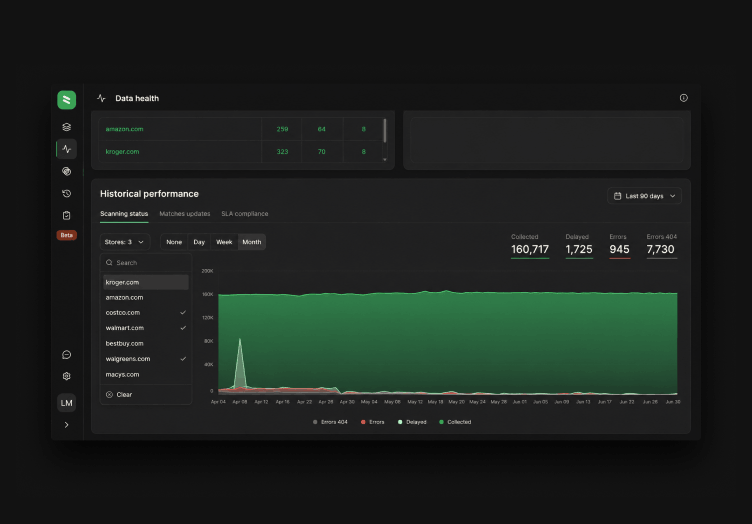
Learn more about pricing simulations.

Cannibalization and halo effects are invisible until it is too late

Enterprise catalogs cannot be treated as collections of independent products. A private label item that is priced too aggressively is going to pull volume from a high-margin branded alternative. Whenever a hero SKU is repriced upward, it also increases the perceived value of adjacent products as well.

Cross-product effects like these (cannibalization and halo, respectively) are real and tangible, but they are also often ignored due to many pricing tools analyzing products in isolation. By the time the category reports catch these issues, the pricing decision that caused it is already going to be multiple weeks old.

Learn more about product cannibalization.

Analytics and pricing execution live in separate systems

A typical analytics setup in enterprise retail uses a combination of three separate tools: a BI tool for reporting, a spreadsheet for modeling, and a separate system, whether a dynamic pricing system or a direct feed into the ERP or POS, for pushing prices.

This splits up the insight from the execution. As a result, analysts identify an opportunity, hand it off to a pricing team, which then rebuilds the logic in a different tool before seeking approval and pushing the change by hand. By the time the decision reaches the shelf, the market has already moved on.

Connecting analytics with execution in the same platform is what helps turn pricing intelligence into pricing outcomes.

Explore the Competera Pricing Platform.

Competera

How Competera's pricing analytics works

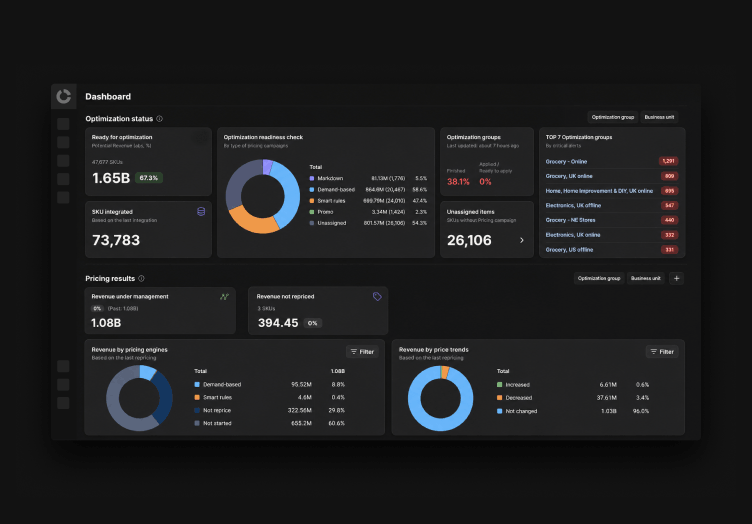
Competera’s pricing analytics tool goes through five specific interconnected steps that build upon each other, creating a continuous learning loop with the goal of improving recommendation accuracy as time goes on.
Step-1-Unified-data-ingestion

Step 1: Unified data ingestion

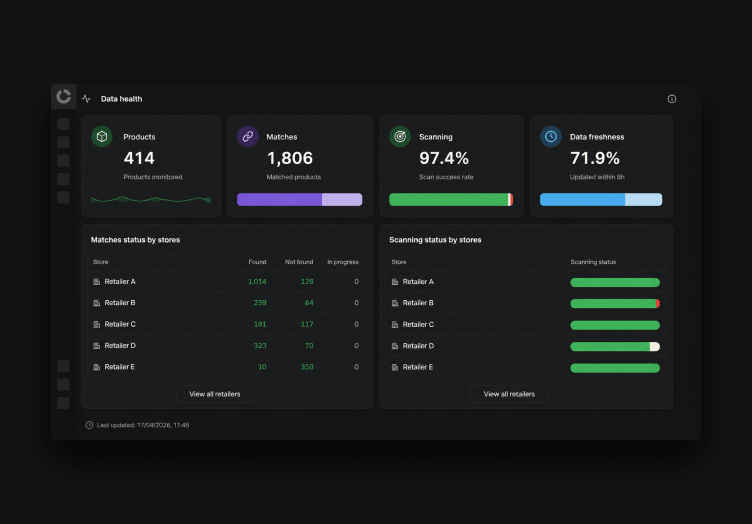
Pricing analytics can only be as good as the data it uses. Competera ingests competitive price data, internal sales and transaction history, cost inputs, promotional calendars, and inventory signals into a single unified data layer. That way, the entire manual data assembly step is eliminated, the same step that used to consume the majority of analyst time in most retail organizations. Competera guarantees that its recommendations are always going to be based on current, complete inputs.

Step-2-Demand-elasticity-modelling-across-20+-factors

Step 2: Demand elasticity modelling across 20+ factors

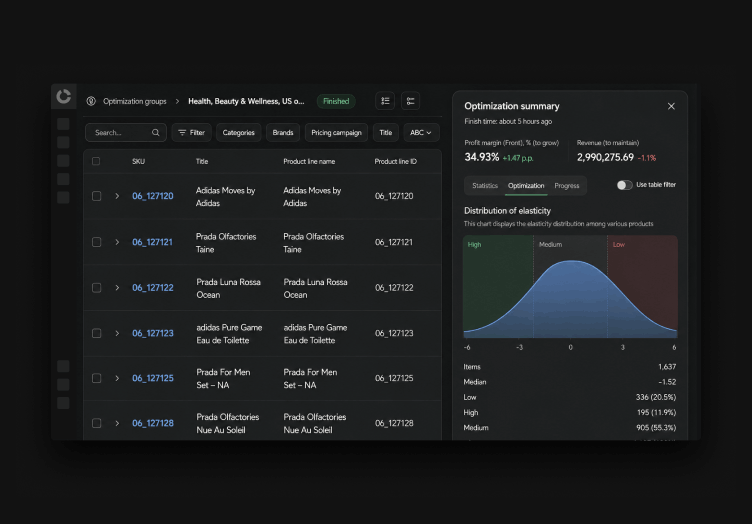
Competera's analytics engine uses a demand elasticity model trained on billions of real retail transactions. It identifies demand's sensitivity to price changes per product across 20+ pricing and non-pricing factors: seasonality, competitor prices, promotions, local market conditions, inventory, and cross-product relationships. What sets true AI pricing analytics apart from rule-based repricing tools is explaining how the market will respond before a price is set.

Step-3-What-if-pricing-simulations

Step 3: What-if pricing simulations

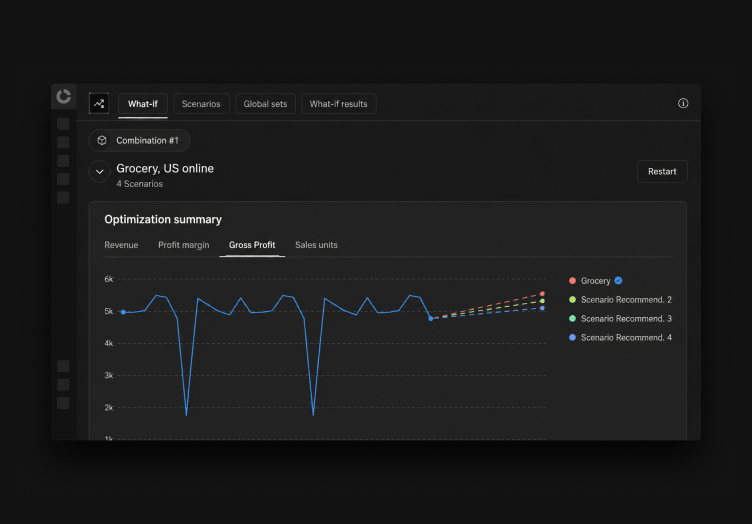
The impact of any price change can be forecasted by using scenario simulation tools. As an example, a category manager can model three alternative pricing strategies against demand history to forecast the margin and revenue implication of each, deciding between the alternatives with a better understanding of the trade-offs. The real power of this functionality is the ability for teams to transition their pricing discussion from “what happened to our price?” to “what will happen if we do this?”.

Step-4-AI-powered-price-recommendations-with-confidence-scoring

Step 4: AI-powered price recommendations with confidence scoring

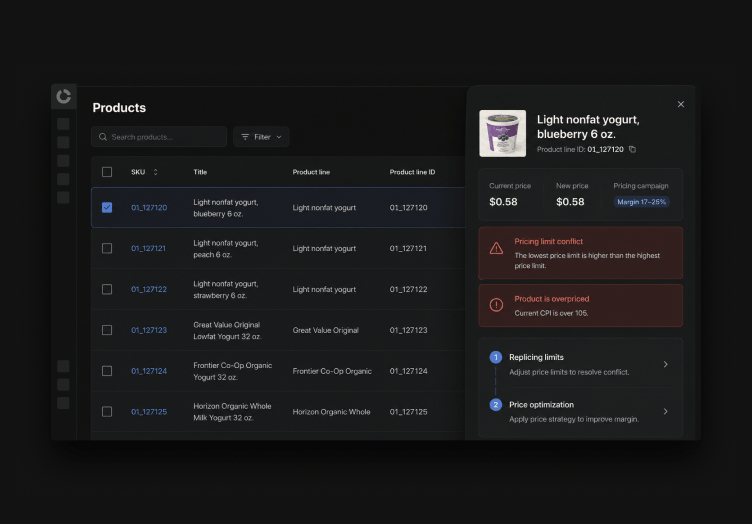
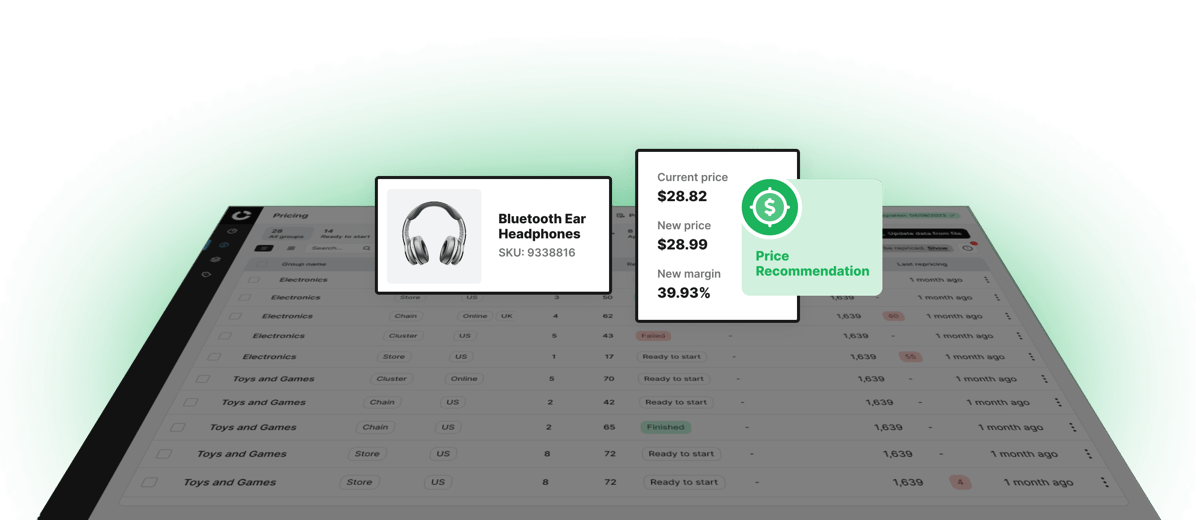
Unlike competitors with black-box outputs, Competera's recommendations come with a confidence score and a visible reasoning layer showing how various factors influenced the decision. Competera's philosophy revolves around human-in-the-loop pricing, and this explainability reinforces it. The technology offers the intelligence, but the decision stays with a manager who can approve, adjust, or override any suggestion.

Step-5-Post-decision-performance-tracking

Step 5: Post-decision performance tracking

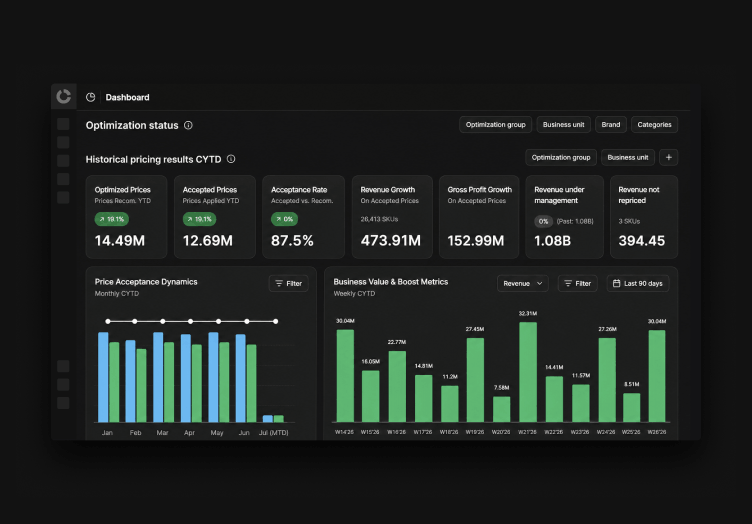
Every price change is a separate data point. Competera monitors the real-life performance of all pricing decisions against projected outcomes, using actual performance as additional data that can improve the demand model while refining its future suggestions. A perpetual learning loop like this is the biggest driver behind the forecast accuracy of over 95%. Pricing teams acquire a clean record of what worked, what didn’t, and why. This way, each pricing cycle turns into an input data for the next one.

How enterprise retailers use Competera's pricing analytics

Icon-Category-managers

Category managers: Pricing decisions with portfolio visibility

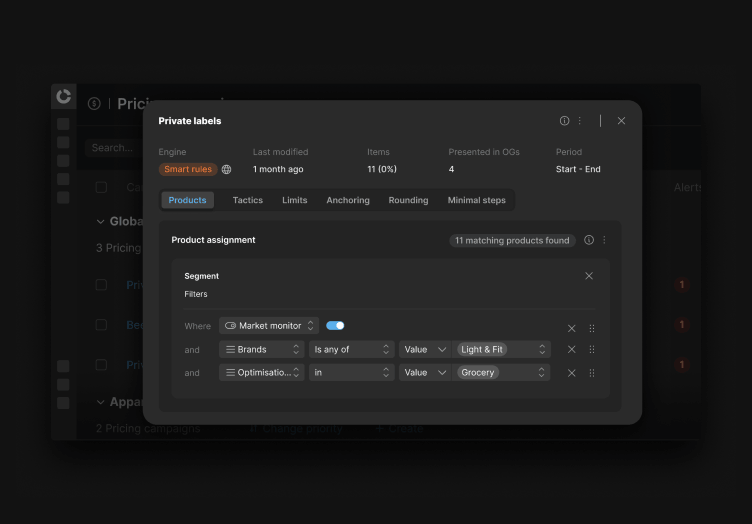
Category managers are accountable for margins and revenue at the category level, while most pricing tools only give them the product-level views. Competera highlights cross-product dynamics (cannibalization risks, halo effects, KVI interactions) to allow category managers to make decisions with the entire portfolio in mind instead of only specific SKUs.

Learn more about KVI pricing
Icon-Pricing-managers

Pricing managers: Faster repricing with measurable outcomes

The efficiency gains from using Competera in the field of price management range from 50% to 70% in repricing workflows. AI-powered recommendations eliminate hours of manual price analysis while the availability of simulation tools ensures that no pricing decision is released without testing and validation. The end result is a faster repricing cycle that attaches measurable outcomes to every change.

Explore faster repricing
Icon-VP-pricing

VP pricing: Pricing KPI tracking and strategy validation

Competera gives pricing leaders a single platform with a clear picture of pricing performance across the portfolio: margin by category, revenue impact of recent changes, forecast accuracy, and competitive positioning over time. Strategic decisions, including new prices and promotions, are driven by actual evidence, not periodic reporting, with the impact of pricing initiatives visible almost in real time.

Learn more about pricing KPIs

Explore more solutions by Competera

See how Competera's AI pricing software drives revenue across every pricing scenario, from omnichannel strategy to competitor tracking and dynamic repricing.
Similar-solution-AI-driven-omnichannel-pricing-solutions

AI-driven omnichannel pricing solutions

Competera's omnichannel pricing software sets consistent, customer-centric prices across online and offline channels from a single AI engine. It aligns pricing decisions across every channel in real time, so retailers grow revenue and protect margins without price conflicts between store and web.

Similar-solution-Price-intelligence-software solutions

Price intelligence software solutions

Competera's price intelligence software gives enterprise retailers a complete, accurate view of the competitive landscape. It collects and matches competitor prices at scale, then turns that data into the insights teams need to make confident, profitable pricing decisions.

Similar-solution-Dynamic-pricing-software-solutions

Dynamic pricing
software solutions

Competera's dynamic pricing software sets the right price for every product, in every store, across every channel. Its AI pricing engine reprices at catalog scale using demand, competitor, and margin signals, helping enterprise retailers protect margins and grow revenue at the same time.

What enterprise retailers achieve with Competera's pricing analytics

  • Faster repricing cycles. From days to minutes, keeping prices current as markets move.

  • Reduced manual workload. Recover 40+ hours per week currently spent on routine execution.

  • Improved pricing accuracy. AI accounts for more factors than any manual process can.

  • Increased revenue and margin. Competera customers see an average 6% margin uplift and 8% revenue growth.

  • Better market responsiveness. Competitor moves and demand shifts reflected in prices within minutes, not days.

  • Operational efficiency. Consistent cross-channel pricing and transparent workflows reduce coordination overhead.

FAQ

01

What is pricing analytics software?

Pricing analytics software gathers, models, and interprets pricing-relevant information in order to assist with making smarter pricing decisions. These tools provide their users with dashboards to track price performance over time, models the elasticity of demand, simulates the potential impact of price changes before executing them, and even offers recommendations based on actual data instead of just rules or intuition.
02

What is the difference between pricing analytics and pricing intelligence?

A central element of pricing intelligence is competitor monitoring, as in looking into how much competitors are chasing and how these prices compare with yours. Pricing analytics is comparatively more advanced, modeling what an increase in price will do as an effect on demand, how this would impact the rest of the portfolio, and if it aligns with the business goals.
03

What is demand elasticity in pricing?

Demand elasticity is a measure of how sensitive customer demands are to price changes. A product with high elasticity sees significant volume changes when its price shifts, while a product with low elasticity holds volume even at higher prices. Being able to understand elasticity at the product level helps pricing teams with customizing pricing offers with margins, revenue, or market share in mind instead of merely matching what competitors offer.
04

What pricing KPIs should retailers track?

The most noteworthy pricing KPIs for enterprise retailers are:
  • Gross margin by category
  • Price index relative to key competitors
  • Revenue impact of pricing changes
  • Forecast accuracy
  • Repricing cycle time
When it comes to the strategic level, retailers should also track the frequency of pricing exceptions outside of defined guardrails and the margin contribution of KVIs.
05

How is AI used in pricing analytics?

AI in pricing analytics models demand at scale, identifies cross-product pricing effects, generates pricing recommendations with confidence scores, and improves the accuracy of forecasting efforts via continuous learning on transaction data. The most important difference between AI-based and rule-based tools is that AI pricing analytics is predictive in nature instead of reactive, allowing it to act before issues appear and explaining how such a prediction was made.

See how Competera's AI pricing analytics works at enterprise scale

Enterprise retailers unifying analytics and pricing execution gain more than just operational efficiency. What they gain is the ability to make pricing decisions with confidence, move faster than competitors, and measure the impact of every single change. If your pricing team is ready to go beyond spreadsheets and backward-looking reports, Competera could be a great choice for your business.
TALK TO AN EXPERT
Price recommendation banner