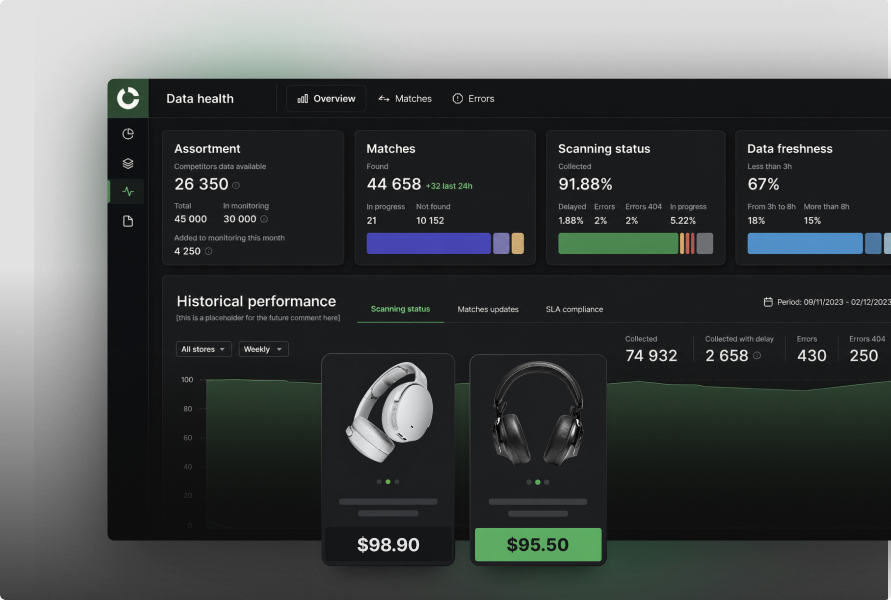




The retail pricing maturity journey
Find your stage
How does your team set prices today?
How much of your competitive landscape do you actively monitor?
How does your pricing team spend most of its time?
What happens when a competitor changes a key price?
How do you handle promotions and markdowns?
What would happen if you needed to change your pricing approach significantly?
Your pricing runs on margins and cost structures.
You have a clear opportunity to gain competitive visibility and start making market-informed pricing decisions. The first step is closing the gap between what you know about the market and what the market knows about you.
Talk to Competera about Competitive Data, which replaces manual monitoring with SLA-controlled competitive intelligence across your full assortment.
Your team is making smart pricing decisions, but the process cannot scale.
Competitor coverage gaps and response time are structural disadvantages that grow wider every quarter. You are ready to automate.
Your rules are fast and reliable, but they treat every product the same regardless of its commercial role.
The margin left on the table is invisible in the P&L, but it compounds. You are ready for demand-led optimization.
Talk to Competera about Contextual AI, which adds a neural-network demand engine reading 20+ factors, extended segmentation, store clustering, and an 85% forecast-accuracy commitment, built on the data you already have.
You are pricing based on demand context across the whole assortment.
Your opportunity now is to extend that intelligence into personalization, reaching the right customer with the right price and offer at the right moment.
Talk to Competera about how your existing data foundation and demand model can extend into customer-level pricing intelligence.
Congratulations!
You are already operating at the highest level of pricing maturity that is known today. That is a rare achievement, and it means your pricing organization has built something most retailers are still working toward.
Trusted by 50+ organizations across the globe

The five stages of retail pricing maturity
Cost-plus pricing: “Take the cost, add our margin, that's the price”
Requirements
-
Basic cost-of-goods data is available for most of the assortment
-
A target margin structure exists, even if informal (department-level or category-level markups)
-
Pricing is handled by buyers or category managers as part of a broader role
-
An ERP or spreadsheet is the primary tool for managing prices
Characteristics
-
Every product gets the same margin logic regardless of market or customer behavior
-
No systematic competitive monitoring beyond occasional manual checks
-
No demand signal: pricing ignores elasticity, overstock, and lifecycle stage
-
Promotions are planned based on gut feel and calendar, not data
Limitations
-
Revenue is left on the table: prices reflect cost, not market willingness to pay
-
Margin erosion is invisible until it shows up in quarterly results
-
High-demand and slow-moving products get the same markup
-
The process is stable but static: no real-time response to market changes
Moving from Stage 1 to Stage 2: from cost-plus to market-driven pricing
Common blockers and solutions
How Competera helps
Real-time competitive intelligence

Stage 2: Manual market-driven pricing: "Check what they're doing so we're not above them"
Requirements
-
A pricing team or pricing function exists, even if within a broader role
-
Some form of competitor price monitoring is in place: manual checks, scraping, or a data feed
-
Spreadsheets or basic BI tools are used for competitive tracking and pricing decisions
-
The organization recognizes that market signals matter, not just cost structure
Characteristics
-
Only 20 to 30% of the competitive landscape is monitored with any regularity
-
More than half of analyst time goes to data gathering, leaving little capacity for strategy
-
Pricing decisions take days; automated competitors respond in hours
-
No structured view of product roles: KVIs, long-tail, overstock, and bestsellers are treated the same way
Limitations
-
Coverage gaps mean decisions are based on an incomplete picture
-
Data gathering consumes the bandwidth the team needs for strategic pricing
-
Competitor response time is a structural disadvantage: hours vs. days
-
Promotional pricing is reactive and broad rather than planned and targeted
Moving from Stage 2 to Stage 3: from manual market-driven to automated rule-based
Common blockers and solutions
How Competera helps
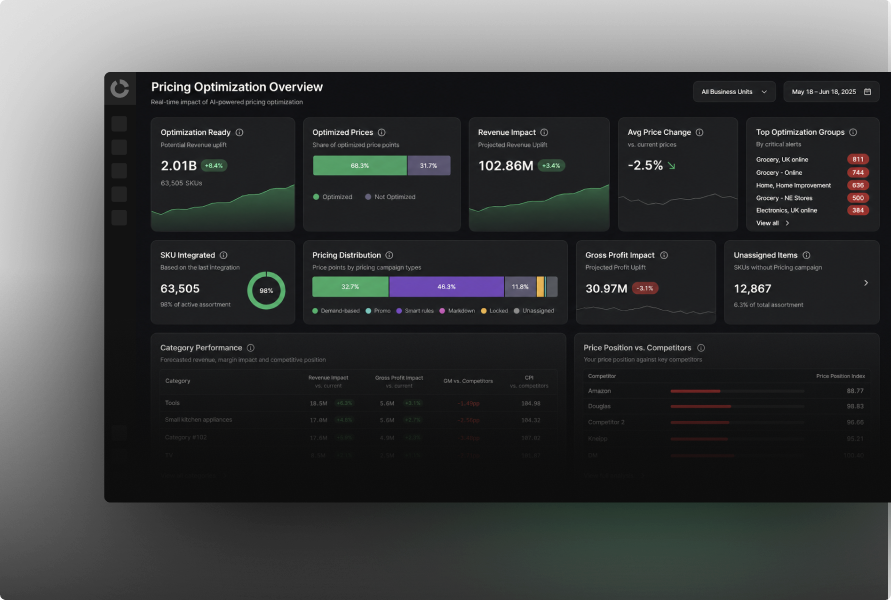
AI-native rules-based pricing
Adaptive AI by Competera adds a statistical engine built on price elasticity to predict how a price change affects sales, with smart segmentation classifying every SKU by role, inventory health, and sales velocity.
It includes a highly adaptable visual rule builder that lets pricing teams create and manage rules without programming, built-in pricing analytics to track the impact of every decision, and needs only 3 months of transactional data history to start.
As Adaptive AI shares the same workspace and data foundation as the rest of the Competera platform, moving to demand-led optimization later is an activation on data the retailer has already built, not a migration to a new vendor.

Stage 3: Automated rule-based pricing: "The system reprices overnight. We set the rules"
Retailers at this stage have solved the execution problem. Prices update automatically, rules run reliably, competitive coverage is high. The system is fast. The problem is that it is commercially blind: it reacts to what competitors do but has no visibility into what each product needs commercially.
Requirements
-
A pricing automation platform or dynamic pricing software is in place and operational
-
Competitive data flows into the system from in-house scraping or a third-party provider
-
Pricing rules are codified: competitor response, margin floors, promotional triggers
-
The team has shifted from data gathering to rule management, though maintenance still dominates
-
Forecasting is limited to price elasticity: how a price change affects volume sold
Characteristics
-
Execution is reliable: repricing runs on schedule, rules fire correctly, coverage is broad
-
Rules react to market signals but have no visibility into demand context
-
A KVI and a slow-moving long-tail item trigger the same rule
-
Overstocked and healthy-inventory products get identical treatment
-
The only explanation for a recommended price is “the rule fired”
-
Strategy calcifies: changing rules written 12 to 18 months ago risks real margin
Limitations
-
Rules perform as designed, so nothing looks broken. But the P&L has no line for the margin a demand-aware price would have captured
-
No automatic product classification by commercial role; every SKU gets the same treatment
-
Promo and markdown pricing lacks inventory, demand, and lifecycle context
-
Upgrading to demand intelligence typically means migrating to a new vendor and losing accumulated data and rules configuration
Moving from Stage 3 to Stage 4: from rule-based to demand-driven optimization
Common blockers and solutions
How Competera helps
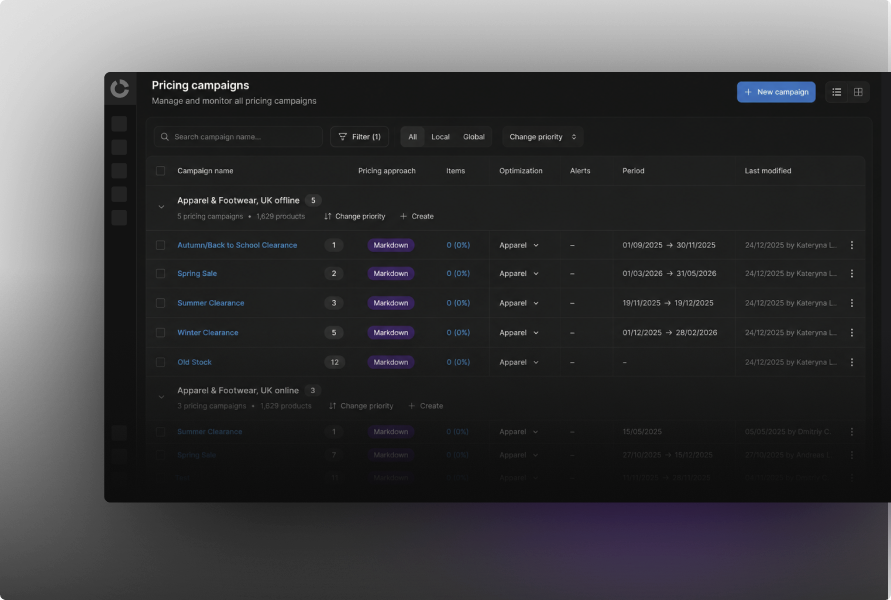
Contextual demand-aware pricing
Contextual AI by Competera adds a neural-network engine that reads 20+ demand-driving factors, from elasticity of demand to inventory health and lifecycle stage, to recommend the optimal price for every product in every store cluster.
It includes extended segmentation scope, automated advanced store clustering, demand-driven scenarios, goal management, A/B testing, integrated promo management to optimize promotional and markdown campaigns alongside regular pricing, and an 85% forecast-accuracy commitment.
Retailers running omnichannel pricing across online and physical stores benefit from a single demand model that reads context across channels. Trained on 24 months of data, Contextual AI is the natural next step for retailers who started with Adaptive AI: the workspace, the data, the configuration, and the team capability all carry forward.
STAGE 4
Stage 4: Optimized customer-centric pricing: “We know what a price change will do to volume and margin before we make it”
At this stage, customer-centric price optimization replaces uniform rules with demand intelligence: a model that reads not just price elasticity but the full context around each product, each store, and each customer segment. The system recommends the optimal price, not just a price that follows a rule. Retailers here are no longer reacting to the market; they are anticipating it.
Requirements
- At least 24 months of clean transaction history available for demand model training
- Data infrastructure integrates internal (transactions, inventory, attributes) and external (competitive, market) data
- The pricing team can interpret model recommendations, set guardrails, and manage by exception
- Category managers no longer set prices directly but define commercial goals and trust the model to recommend prices that achieve them
- Product segmentation and store clustering are in place: KVIs, basket builders, traffic generators, markdown candidates
Characteristics
- A demand model considers demand-driving factors simultaneously: elasticity of demand, inventory health, seasonality, competitor moves, product lifecycle stage, basket behavior, and more
- Smart segmentation classifies every product by commercial role; store clustering maps to dedicated pricing campaigns
- “Grow” and “maintain” goals define what each cluster optimizes for: revenue, volume, profit, or keeping current commercial KPIs steady
- Intelligent product relationship management keeps repricing across the entire portfolio consistent
- Scenario planning and simulation let the team test strategies before going live
Limitations
- Shifting from rule-based to demand-led pricing requires change management and trust in price recommendations generated by the AI models
- Data quality becomes the bottleneck: gaps in history, inventory, or product attributes directly reduce forecast accuracy
- The question shifts to extending demand intelligence into promo, markdown, new markets, and eventually personalization
Moving from Stage 4 to Stage 5: from optimized customer-centric to personalized pricing
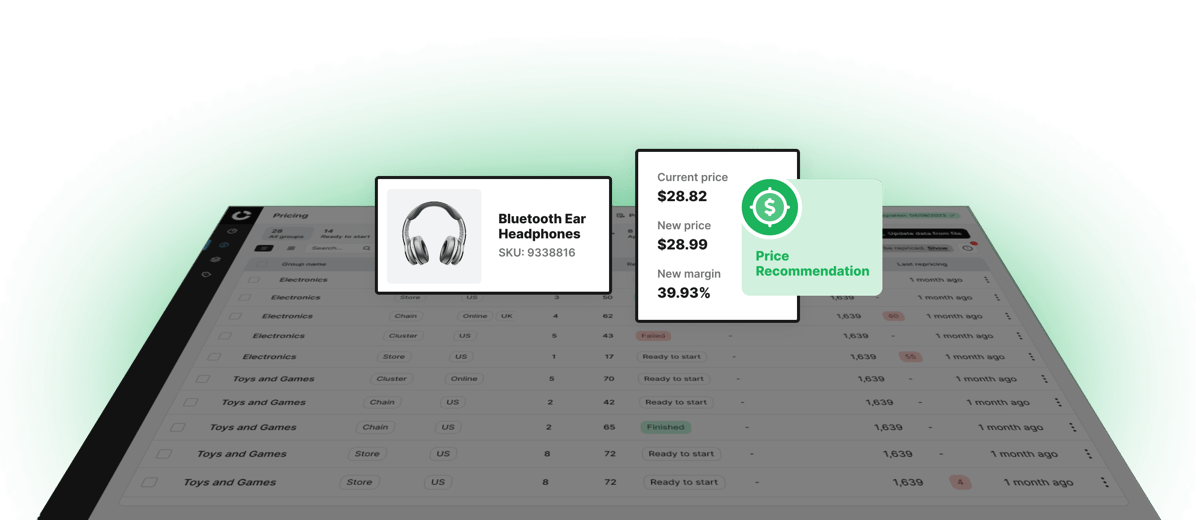
STAGE 5
Stage 5: Personalized pricing
This is the theoretical frontier of pricing maturity. In concept, prices and offers are tailored not just by product and store but by customer segment or individual customer behavior. The competitive moat would be at its widest: pricing intelligence reflecting a depth of customer understanding that cannot be replicated without the same data foundation and modeling capability. Stage 5 extends customer-centric pricing to its fullest theoretical expression, but the industry has not yet established the technical, regulatory, or ethical foundations to make it operational at scale.
Requirements
- A mature demand model is operational and has been validated across the assortment
- Full customer data integration: CRM, loyalty, behavioral, and purchase history flow into pricing
- Advanced AI/ML capability is available in-house or through a platform partner
- A clear data governance framework covers customer data use in pricing
- Pricing, marketing, and merchandising operate on shared data, not in silos
- Industry-wide consensus on ethical guardrails for customer-level pricing, which does not yet exist
Characteristics
- Prices and offers reflect customer-level willingness to pay, purchase frequency, basket, and channel preference
- Personalized promotions replace blanket discounting: right offer, right customer, right time
- Pricing integrates seamlessly with CRM and marketing automation as part of a unified customer experience
Limitations
- Privacy and regulatory compliance (GDPR, consumer protection) set hard boundaries on permissible personalization, and the boundaries are still evolving
- Personalized pricing must feel fair, not extractive. Customer perception risk is high and amplified by social media transparency
- No vendor on the market currently offers a proven solution for individual-level pricing at scale
- No evidence yet that individual-level pricing outperforms well-executed demand-led optimization at Stage 4
Cost of inaction in retail pricing
How Competera meets your pricing needs today and builds the foundation for tomorrow
From day one, Adaptive AI accumulates structured transactional data, enriches product segmentation, and trains your team to work in a model-assisted environment. By the time you are ready for Contextual AI, the 24 months of clean history the demand model requires have been building in the background. Workspace, segmentation logic, rule library, and team fluency all carry forward
Unlock your retail's full potential
Connect with our pricing experts to discover how Competera can drive predictable growth and lasting customer loyalty for your retail enterprise
FAQ
What is a pricing maturity model?
A pricing maturity model is a framework that describes how retailers progress through distinct stages of pricing sophistication, from basic cost-plus markup to fully personalized, AI-driven pricing. The model most widely referenced in the industry comes from Gartner's Market Guide for Unified Price, Promotion and Markdown Optimization Applications, which defines five stages based on the data, processes, and technology a retailer uses to set and manage prices.
The value of the model is diagnostic. It gives pricing leaders a shared language to describe where the organization is today, what capability gaps exist, and what the next stage requires in terms of data readiness, team capability, and technology infrastructure. It also makes visible the commercial cost of staying at a given stage: the margin and revenue that a more sophisticated approach would recover.
Competera’s platform is built around this framework. Each of Competera’s packages, Competitive Data, Adaptive AI, and Contextual AI, maps to a specific stage on the journey, so a retailer can enter at the stage that matches their current maturity and progress to the next without changing vendor, losing data history, or rebuilding configuration.
What stage are most retailers at?
Along the pricing maturity journey, the majority of mid-market and large retailers in Europe and North America currently operate at Stage 2 (manual market-driven) or Stage 3 (automated rule-based). These are also the two stages where the gap between current retail pricing maturity and what is now technologically possible is widest.
At Stage 2, the pricing team monitors competitors and adjusts prices manually, but typically covers only 20 to 30% of the relevant competitive landscape with any real frequency. More than half of analyst time goes to data gathering rather than strategy, and response time is measured in days while automated competitors respond in hours.
At Stage 3, execution is fast and reliable, but the system is commercially blind. Rules fire without knowing what each product needs: a high-demand KVI and a slow-moving long-tail item trigger the same logic, and an overstocked product approaching end of life gets treated identically to a healthy bestseller. The margin that demand-context-aware pricing would recover is invisible in the P&L because the rules are working on the surface.
Both stages carry a compounding cost of inaction: 2 to 4% gross margin unrealized annually, 1 to 2% revenue lost to coverage gaps, and 3 to 5% margin lost on promotional and markdown decisions made without simulation or demand data.
What does moving from Stage 3 to Stage 4 require?
This is the most commercially significant pricing transformation on the journey, and the one where the choice of platform matters most.
From a data perspective, a high-accuracy demand model requires at least 24 months of clean transaction history. Retailers who have been operating at Stage 3 for over a year typically have more data than they realize; the question is whether it is structured and accessible. A platform that has been accumulating and enriching data since Stage 3 turns this from a blocker into an asset.
From an organizational perspective, the shift is from managing pricing by rule to managing by goal and exception. The pricing team stops writing and maintaining individual rules and starts setting commercial objectives (grow revenue in this cluster, protect margin in that one) and reviewing model recommendations within guardrails. This requires executive sponsorship and a willingness to let the model do the work it is designed to do, with human oversight focused on strategy and exceptions.
From a technology perspective, this is where platform choice becomes decisive. Retailers who chose a rules-only platform at Stage 3 face a full migration to a different vendor: new data integration, new configuration, new learning curve, lost data history. Retailers who chose a platform built for the full maturity journey activate demand-led optimization on the workspace, data, and configuration they have already built. With Competera, moving from Adaptive AI to Contextual AI is an activation, not a migration.
Does Competera work for retailers at every stage?
Yes. Competera is built to serve the full pricing maturity journey, from a retailer running manual competitor checks in spreadsheets to one deploying contextual AI pricing across every store cluster, channel, and product role.
The platform offers three entry points that map directly to the journey. Competitive Data provides SLA-controlled price monitoring for retailers at Stage 1 or 2 who need to replace manual processes with structured, current competitive intelligence. Adaptive AI adds a statistical pricing engine built on price elasticity, a visual rule builder, and smart segmentation for retailers at Stage 3 who are ready for automated, price-led optimization; it needs only 3 months of transaction history to start. Contextual AI adds a neural-network engine reading 20+ demand-driving factors for retailers at Stage 4 and beyond who are ready for demand-led optimization; it comes with an 85% forecast-accuracy commitment.
The critical differentiator is that moving between packages does not require changing vendor, rebuilding data architecture, or losing the configuration and team capability built at the previous stage. The workspace, the data, and the enrichment compound and carry forward. A retailer who starts with Competitive Data and eventually reaches Contextual AI arrives there with years of accumulated data and team knowledge that make the deployment immediately more powerful than starting from scratch.
How do we assess where we are on the journey?
The pricing maturity assessment on this page is a starting point. It asks six questions about how your organization sets prices, monitors the competitive landscape, allocates team time, responds to competitor moves, handles promotions and markdowns, and manages strategic change. The pattern of your answers maps to a maturity stage.
For a deeper assessment, Competera’s team can work with you to diagnose your current stage based on your actual data infrastructure, team workflow, and pricing process, and quantify the commercial opportunity of moving forward. This is not a generic benchmarking exercise; it is grounded in the specific economics of your assortment, your competitive landscape, and your current pricing performance. Every Competera pilot begins with commercial KPIs agreed upfront, so the business case is concrete before deployment starts.
How long does it take to move from one stage to the next?
Timeline depends on the starting point, the data readiness, and the organizational commitment, but the technology is rarely the bottleneck.
Moving from Stage 1 or 2 to Stage 3 with Competera can happen in weeks. Adaptive AI needs only 3 months of transaction history to begin, and the visual rule builder lets teams codify their pricing logic without programming. Deployment to first live pricing recommendations can take as little as 2 weeks.
Moving from Stage 3 to Stage 4 typically requires more preparation because the demand model needs 24 months of history and the organizational shift from rule-based to model-driven pricing involves change management. For retailers who started at Stage 3 on Competera, the data has been accumulating from day one, and the transition to Contextual AI is an activation on data that already exists, not a migration that resets the clock. In practice, many Competera clients start on Adaptive AI to get pricing under control quickly, build internal ownership of the system over 12 to 18 months, and then move to Contextual AI when the data depth and team readiness align.
The single biggest factor in timeline is not the technology but the platform choice. Retailers who chose a vendor that only serves their current stage face a full migration at every step of the pricing maturity journey: new data integration, new configuration, new training, typically measured in months. Retailers who chose a grow-with-you platform convert that migration time into compounding value.
What is the difference between rule-based and AI-driven pricing optimization?
Rule-based pricing optimization executes predefined logic: if a competitor drops a price, match it within a margin floor; if inventory exceeds a threshold, trigger a markdown. The rules are fast and reliable, but they treat every product the same way regardless of what it needs commercially. A KVI that customers actively price-check and a slow-moving long-tail item with no competitive sensitivity fire the same rule. The system reacts to signals but has no understanding of why a particular price is right for a particular product at a particular moment.
AI-driven pricing optimization adds a demand intelligence layer. Instead of following rules, the system reads demand context: price elasticity, inventory health, seasonality, competitor positioning, product lifecycle stage, and basket behavior. It recommends a price based on what will achieve the commercial objective, whether that is revenue growth, margin protection, or volume, for each product in each store cluster. The pricing team shifts from writing and maintaining rules to setting goals and guardrails and managing by exception.
The practical difference shows up in the margin the system recovers. Rules leave money on the table because they cannot distinguish between products that need different treatment. AI-driven pricing optimization sees the distinction and prices accordingly. With Competera, the transition from rule-based (Adaptive AI) to AI-driven demand optimization (Contextual AI) happens on the same platform, with no migration and no data loss.
Can you skip stages in the pricing maturity journey?
Not in a way that produces durable results. Each stage builds the data foundation, team capability, and organizational readiness that the next stage requires.
The most common example: a retailer at Stage 2 (manual market-driven) wants to jump directly to Stage 4 (demand-led optimization). The problem is that a high-accuracy demand model needs at least 24 months of clean, structured transaction history, product segmentation data, and competitive pricing data flowing consistently into the system. A retailer that has not automated data collection and built a structured pricing workflow (Stage 3 capabilities) will not have the data quality or the team discipline to operate effectively at Stage 4.
What is possible, and what Competera is designed for, is compressing the time spent at each stage. A retailer can start with Adaptive AI at Stage 3, begin accumulating structured data from day one, build team capability on the platform, and move to Contextual AI at Stage 4 faster than they would on a platform that requires a full migration at every transition. The stages are sequential, but the time between them is not fixed. It depends on data readiness, organizational commitment, and whether the pricing strategy and platform were chosen with the full journey in mind.
Please fill out the form to watch the product tour
Loading form...