


On January 29, 2026, Competera, an AI-driven pricing and competitive intelligence platform, and NOVUS, a leading grocery retailer in Ukraine, joined SAP for an episode of the DATARetail and WSD Series. Drawing on NOVUS’s real-world experience, the discussion focused on what it actually takes to move from Excel- and rule-based pricing to AI-driven, contextual optimization, and what results retailers can expect when data, technology, and people are aligned.
Speakers
Alex Halkin, CEO of Competera
Founder and CEO of Competera, Alex brings deep experience in retail pricing, AI-driven optimization, and enterprise pricing transformation. He has spent years helping global retailers replace manual pricing processes with scalable, data-driven decision-making.
Mazvydas Stundzia, CIO of NOVUS
As CIO of NOVUS, Mazvydas leads digital transformation initiatives across one of Ukraine’s largest grocery retailers. With more than 25 years of experience in retail and IT, he focuses on turning data and technology into measurable business outcomes.
Florian Roeder, Senior Solution Specialist, Data & AI, SAP Industries and Experience
Florian works with retailers globally to design and implement SAP-based data and AI architectures. He helps organizations build the data foundations required to scale AI use cases across pricing, supply chain, and operations.
The pricing challenges NOVUS faced
Like many grocery retailers, NOVUS operates in a highly competitive environment with thin margins, frequent promotions, and constant price pressure. Over time, pricing complexity increased significantly:
- Multiple store formats with different customer behavior patterns
- A large and diverse assortment of roughly 30,000 SKUs
- Strong competition at both local and national levels
- Heavy reliance on manual pricing processes and Excel-based workflows
Traditional pricing rules helped provide control, but they also introduced rigidity. Over the years, pricing teams accumulated 30+ rules designed to protect margins or enforce consistency. Eventually, those rules became difficult to manage, hard to explain, and nearly impossible to scale.
At the same time, promotions and markdowns were often reactive. Individual SKUs might perform well, but category-level margins suffered due to cross-product effects that were difficult to anticipate manually.
NOVUS recognized that scaling pricing decisions with spreadsheets and static rules was no longer sustainable.
Why NOVUS chose an AI-driven pricing approach
From the beginning, NOVUS took a pragmatic approach to AI. As Mazvydas Stundzia emphasized during the session, AI was never adopted “for the sake of AI.” Every initiative had to be backed by a clear business case.
The NOVUS pricing team defined several core objectives:
- Optimize prices at the store and store-cluster level
- Grow profit without compromising revenue
- Remain competitive without defaulting to “cheapest” positioning
- Reflect the reality that customers perceive pricing across the whole store, not individual SKUs
NOVUS understood that pricing decisions are contextual. Store location, format, competition, promotions, traffic, and even weather all influence how customers respond to price changes. Static rules and manual workflows simply couldn’t capture that complexity at scale.
This led NOVUS to deliberately seek an AI-driven and retail-ready pricing solution rather than a traditional rule-based system with AI layered on top.
The solution: Competera’s contextual AI pricing engine
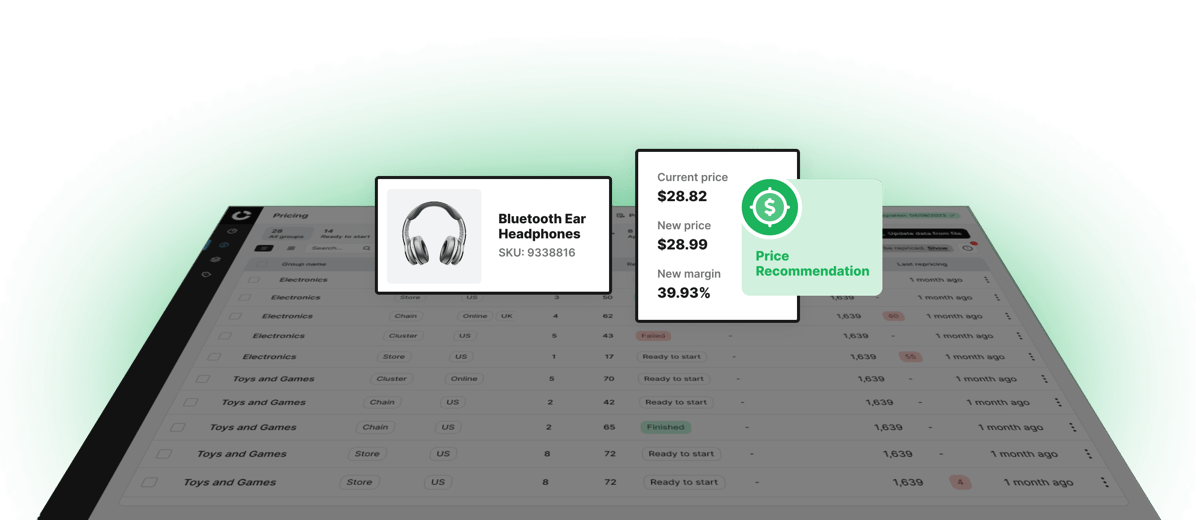
Competera’s approach to pricing is built around a contextual AI. Instead of relying on predefined pricing rules, Competera Pricing Platform continuously learns from data and optimizes prices by evaluating multiple types of elasticities simultaneously.
These include:
- Demand-, product-, and category-level elasticities
- Store-, store-cluster-, and customer-segment behavior
- Promotional activities and their impact
- Competitive positioning, pricing strategy, and competitor proximity
- External signals such as traffic patterns, location context, weather, and other relevant factors
Unlike “black box” systems, Competera uses a “glass box” approach, allowing users to understand which factors influence pricing recommendations. This transparency proved critical for user trust and adoption.
Another key differentiator discussed in the session was continuous learning. Competera’s models are retrained on a regular cadence:
- Daily for online pricing scenarios
- Weekly for offline store pricing cycles
This ensures pricing recommendations always reflect the most recent data and market conditions.
Project setup: from data foundation to pilot
One reason NOVUS was able to move quickly is its strong SAP data foundation. Roughly 85% of the required data was already available and well structured within SAP systems, including transaction-level data and detailed promotion history.
The project followed a clear set of implementation milestones:
- Data integration to understand where data resides
- Data validation and transformation to ensure quality and consistency
- Store clustering and product segmentation, recognizing that not all stores and SKUs behave the same
- Review and relaxation of pricing guardrails, shifting focus from item-level margins to overall business performance
- Super-user training to support adoption and change management
To build confidence, NOVUS and Competera launched a controlled pilot:
- 10 stores
- Selected product categories
- Test and control groups
- 56-day duration
This A/B testing approach allowed NOVUS to measure impact objectively before scaling.
Results: what AI pricing delivered for NOVUS
The pilot delivered clear, measurable results. NOVUS saw gross profit uplift across multiple categories, without sacrificing revenue. Importantly, pricing changes were incremental, often fractions of a percent, but at scale, those adjustments translated into meaningful financial gains.
One of the most insightful metrics was price acceptance rate. This tracked how often users accepted AI-recommended prices without overrides. Categories with higher acceptance rates consistently delivered better results, reinforcing trust in the system.
Over time, adoption accelerated. Today, pricing teams at NOVUS rely on AI daily. What once required large teams working in Microsoft Excel is now managed by a smaller number of skilled professionals overseeing AI-driven optimization.
Key highlights from the live Q&A session
Several audience questions highlighted practical concerns many retailers share:
How often are Competera’s AI models retrained?
Continuously, aligned with pricing cycles, ensuring recommendations remain relevant.
What about non-SAP data sources?
Competera integrates both SAP and non-SAP data, including traffic sensors and competitive location data, strengthening the model with every new signal.
Which retail domains benefit most from AI pricing?
High-volume, large-assortment retailers such as grocery, pharmacy, DIY, and drugstores see the greatest impact.
Mazvydas also shared a grocery-specific insight: the biggest pricing opportunity lies beyond key value items (KVIs). While KVIs must remain tightly competitive, the rest of the assortment offers significant potential for optimization, especially when managed at scale with AI.
TL;DR: key takeaways for retail leaders
- AI pricing only works with a strong data foundation
- Context matters more than price alone
- Rule-based pricing does not scale in complex retail environments
- Small price changes at scale drive meaningful profit impact
- Grocery retailers benefit most from AI pricing beyond KVIs
- AI doesn’t replace people; it amplifies their impact
As this session made clear, successful AI pricing isn’t about replacing human judgment. It’s about enabling pricing teams to operate at a level of scale, speed, and precision that simply isn’t possible with spreadsheets and static rules.
For retailers serious about profitability in an increasingly complex market, the path forward is clear: data first, context always, humans in the loop.
About NOVUS:
NOVUS is one of the leading grocery retailers in Ukraine, operating more than 150 stores across multiple formats.
About SAP:
SAP is one of the world’s market leaders for business software, with over 100,000 employees and more than 440,000 customers worldwide.
About Competera:
Competera is an enterprise-grade pricing platform that uncovers the true drivers of demand. By understanding customer behavior and demand elasticity, Competera empowers retailers to deliver prices their customers trust – and results their business can measure.
.png)