



TL;DR
- Machine learning price optimization sets prices by modeling how demand responds to price, competition, and dozens of other factors at once, replacing fixed rules and manual guesswork.
- It scales pricing across thousands of products without adding proportional headcount, and reprices in near real time as competitive and demand signals move.
- Teams can simulate the revenue and margin impact of a price before it goes live, turning a high-stakes guess into a measured decision.
- Human control remains central through explainability, guardrails, and override authority, thereby protecting customer trust. This is important today since 68% of consumers say they feel taken advantage of by dynamic pricing.
- Competera reports that retailers on its platform achieve 3–7% revenue growth and 2–5 percentage-point gains in gross margin, with prediction accuracy above 95%.
What is machine learning price optimization?
Machine learning price optimization is a data-driven method that sets prices by predicting customer responses and then recommending the price that best meets a defined goal, such as revenue, margin, or sell-through. It replaces manual estimates and fixed rules with models that weigh many demand and non-demand factors simultaneously and update as new data arrive.
How it differs from rules-based pricing
Machine learning price optimization differs from rules-based pricing in scope and adaptability. Rules-based pricing applies fixed logic, such as matching a competitor or adding a set margin, and responds only to the signals encoded in each rule. Machine learning weighs many factors together and recommends prices that move with the market, then predicts the revenue and margin impact before a change goes live.
The table below compares the two approaches.
| Dimension | Rules-based pricing | Machine learning price optimization |
| Speed of adaptation | Reacts only when a hardcoded rule is explicitly triggered. | Calculates optimizations continuously, adapting as market data changes. |
| SKU coverage | Practical only for limited rule sets; rules can conflict at scale. | Scales effortlessly across thousands of complex stock-keeping units (SKUs). |
| Response to demand | Blind to demand context; ignores price elasticity and volume trade-offs. | Prices dynamically to modeled demand response and consumer willingness to pay. |
| Forecast accuracy | No prediction of outcomes; relies entirely on backward-looking data. | Forecasts revenue and margin impact through predictive simulations before repricing. |
| Team workload | High. Requires manual rule maintenance, auditing, and constant troubleshooting. | Low. Shifts the team to managing automated recommendations with human oversight. |
| Data dependency | Low. Can function immediately on basic logic (e.g., cost-plus) with zero sales history. | Higher, though the platform is built to model reliably even in data-light environments. |
Rules-based pricing versus machine learning price optimization.
Fixed rules are generally rigid. When market demand shifts, static algorithmic pricing continues to rely on outdated logic. Updating it usually requires live testing, which risks losing real revenue.
In contrast, a model-based approach automatically adapts within your team's guardrails, keeping your pricing strategy current without the need for constant manual rewrites.
To see how these methods work in practice, read Competera's guide to price optimization models.
How machine learning models are trained for retail pricing
Machine learning models learn from a retailer's own history before they recommend a single price. During training, the model studies how past prices, sales, competitor moves, and seasonal patterns influenced demand. It then tests its predictions against historical results until it is sufficiently accurate for a pilot program.
The data inputs that drive pricing recommendations
Pricing recommendations rely on the everyday factors that drive customer demand: historical sales, competitor prices, inventory levels, seasons, and shopping trends. Handling all of these moving parts at once is what separates a machine learning model from a rigid rule. To ensure reliable demand forecasting, a system must combine a retailer's own transaction history with live, competitive market data.
According to McKinsey, AI-driven forecasting models outperform traditional spreadsheets because they process real-time data and automatically spot new demand patterns, rather than waiting for manual updates.
However, a model is only as strong as the data behind it, and retail data is rarely complete. Records arrive in incompatible formats, lack context, or miss chunks of competitor history. A well-built model handles this mess easily. The platform unifies everything into a single view, fills missing gaps using related market patterns, and estimates values where records do not exist. If the system is less confident about a specific recommendation, it flags that price for a manager to review instead of presenting a guess as an absolute fact.
How the model learns and improves
The model tracks how price changes affect sales for every product, and it gets smarter with every pricing cycle. Every new price update creates new data for the model to analyze, making its recommendations increasingly accurate over time.
This approach makes price elasticity highly practical. Instead of assigning a single, rigid elasticity score to an item, the model tracks how price sensitivity shifts with the product's role, sales channel, store location, and season. This closely mirrors real customer behavior, allowing retailers to protect their profit margins without driving shoppers away.
What machine learning pricing does in practice for enterprise retailers
In daily operations, machine learning pricing does three things a manual process cannot do at scale: it prices a large assortment without a larger team, it reacts to the market within hours, and it tests decisions before they reach the shelf. Each capability turns a slow, high-effort task into a fast and repeatable one.
The subsections below show where enterprise retailers see the most value.
Pricing across thousands of SKUs without proportional headcount
Machine learning enables a pricing team to manage thousands of SKUs without hiring additional staff as the assortment grows. Since the model generates recommendations for the full portfolio at once, analysts move from manually calculating individual prices to reviewing and approving the system's proposals.
Competera reports that this shift from rules-based pricing to machine learning optimization delivers 50–70% efficiency gains, freeing analysts to focus on strategy and category planning rather than spreadsheet upkeep.
Responding to competitive and demand signals in near real time
Machine learning reprices in near real time as competitive and demand signals change. When a competitor drops prices or demand spikes, the model reflects the change in the next cycle rather than waiting for a manual review days later.
This is the foundation of effective dynamic pricing, where prices adjust to market conditions inside the guardrails a retailer sets. Machine learning dynamic pricing keeps that responsiveness aligned with margin floors, competitor limits, and brand rules, so speed never comes at the cost of strategy or customer trust.
Simulating outcomes before prices go live
Machine learning lets teams simulate revenue and margin outcomes before any price goes live. Using pricing simulations, a team can test a promotion or a new strategy, see the predicted impact with a probability rating, and choose the option that best fits the goal. That turns a high-stakes guess into a measured decision, protecting margin without gambling on how customers will respond.
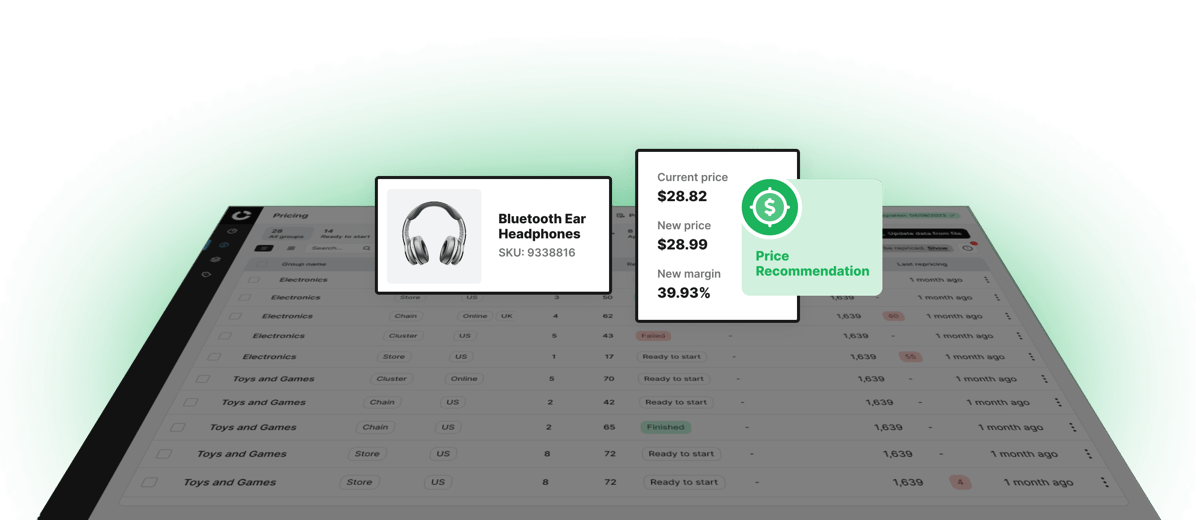
Competera’s Pricing Platform combines machine learning-driven price recommendations with what-if simulations and human override controls.
Human oversight in machine learning pricing
Machine learning improves pricing decisions, but people always make the final call. The most successful retail deployments pair automated recommendations with absolute transparency and clear override authority. This balance ensures that technology serves the strategy, protecting both profit margins and customer trust.
Explainability and override controls
Explainability means a pricing manager can see exactly why a system recommended a specific price, and can change it instantly when human judgment dictates. The Competera Pricing Platform surfaces the specific market factors behind every recommendation and enforces strict price floors, ceilings, and business rules your team defines, ensuring no price ever breaches a guardrail or gets hidden inside a "black box."
Today, this human guardrail is a commercial necessity, not just an operational one. A 2024 Gartner survey found that 68% of consumers feel taken advantage of when brands use dynamic pricing, while 80% view brands with consistent pricing as more trustworthy. By keeping pricing explainable and governed, enterprise retailers can aggressively defend their margins while protecting the perception of fair pricing that keeps customers loyal.
What machine learning price optimization delivers for enterprise retailers
Machine learning price optimization delivers measurable gains in revenue, margin, and team efficiency while keeping prices aligned with customer value. These are real, present-day outcomes that retailers report right now, not just promises of future capability. Competera documents the following average results for retailers using its platform:
- Revenue growth of 3–7% from optimized portfolio-level pricing.
- Gross margin uplift of 2–5 percentage points from goal-driven pricing.
- Efficiency gains of 50–70% in pricing team workload.
- Forecast accuracy above 95% on revenue and margin impact before any price goes live.
- 20+ demand and non-demand factors modeled simultaneously.
Case in point: an Eastern European supermarket chain increased profit by 7% within eight weeks of deploying Competera, after resolving cross-elasticity challenges that manual pricing could not.
These results also hold up to outside scrutiny. Competera has been named a Representative Vendor for three consecutive years in the Gartner Market Guide for Retail Unified Price, Promotion and Markdown Optimization Applications, Short Life Cycle.
To see how these machine learning price-optimization benefits fit into a broader pricing strategy, read Competera's guide to AI-driven pricing.
Conclusion
Machine learning price optimization gives enterprise retailers a scalable, data-backed method to price with speed and precision while keeping people in control of overall strategy. The technology models demand across thousands of products simultaneously, adapts to competitive shifts in near real time, and lets teams safely test the revenue impact of a decision before it ever reaches the shelf.
As shoppers weigh value more carefully and grow wary of prices that change without clear reason, a strategy that protects profit margins and customer trust simultaneously becomes a durable competitive advantage. The Competera Pricing Platform brings these capabilities together in a single system built specifically for retail teams, offering the exact explainability and override controls that keep pricing managers in charge.
Book a demo to see it applied to your assortment today.

References
- Gartner. (2024, December 16). Gartner marketing survey finds 68% of consumers report they feel taken advantage of when brands use dynamic pricing. [Press release]
- Amar, J., Rahimi, S., Surak, Z., & von Bismarck, N. (2022, February). AI-driven operations forecasting in data-light environments. McKinsey & Company.
- Thomasson, A. (2025, July 4). Competera in 2024 Gartner Market Guide. Competera.
.png)