



Cost-plus pricing sets a selling price by adding a fixed markup to the total cost of producing or sourcing a product. It gives retailers a clear cost floor, but the calculation doesn’t account for demand, competitor moves, product roles, or customer willingness to pay.
TL;DR
- The cost-plus pricing formula adds a markup to the defined cost base per unit.
- It works best for niche products, private labels, low-competition categories, and early-stage retailers.
- The method struggles when customer willingness to pay, competitive pressure, and product role enter the picture.
- Enterprise retailers often keep cost-plus pricing as a floor and layer in demand-based or value-based pricing.
What is cost-plus pricing?
The cost-plus pricing method calculates a selling price by adding a fixed markup to a product’s total cost. The cost base can include acquisition or production costs alone, or a broader combination of direct costs and allocated overhead, depending on how a retailer defines cost.
It’s one of the simplest pricing approaches because the logic is easy to trace, explain, and audit. However, it relies entirely on internal cost data, with no input from competitor prices or customer demand.
How cost-plus pricing differs from other pricing methods
Cost-plus pricing sits inside the broader cost-based pricing category, in which a markup is added to a defined cost base. What separates the cost-plus pricing method from other methods is the data it derives. Here are the considerations of different pricing methods:
- Cost-plus pricing: Product cost and the markup needed to set the selling price.
- Demand-based pricing: How customer demand responds at different price points.
- Value-based pricing: What customers are willing to pay based on perceived value.
- Market-driven pricing: Competitor prices and the retailer’s desired market position.
The cost-plus pricing formula
The cost-plus pricing formula is a three-step calculation: identify cost per unit, choose a markup percentage, and apply that markup to set the selling price.
The formula
The formula for cost-plus pricing goes like this:
Selling price = Cost + (Cost × Markup percentage)
To calculate the markup percentage from an existing selling price:
Markup = (Selling price – Cost) ÷ Cost x 100
Retailers also need to define what costs include. A calculation based only on acquisition cost will differ from one that allocates freight, handling, labor, or overhead to each unit.
Markup vs. margin: the key distinction
Markup measures the amount added to the cost, while margin measures gross profit as a percentage of the selling price. Using these terms interchangeably can lead retailers to set a different price from what’s needed to meet their intended margin target.
The formula to calculate profit margin is:
Margin = (Selling price − Cost) ÷ Selling price × 100
Consider a product that costs $80 and sells at $100 for a $20 gross profit:
- Markup = ($100 − $80) ÷ $80 × 100 = 25%
- Margin = ($100 − $80) ÷ $100 × 100 = 20%
The same $20 gross profit produces different percentages because markup uses cost as the denominator, while margin uses selling price. For retailers working toward a specific margin target, this distinction affects the price they need to set.
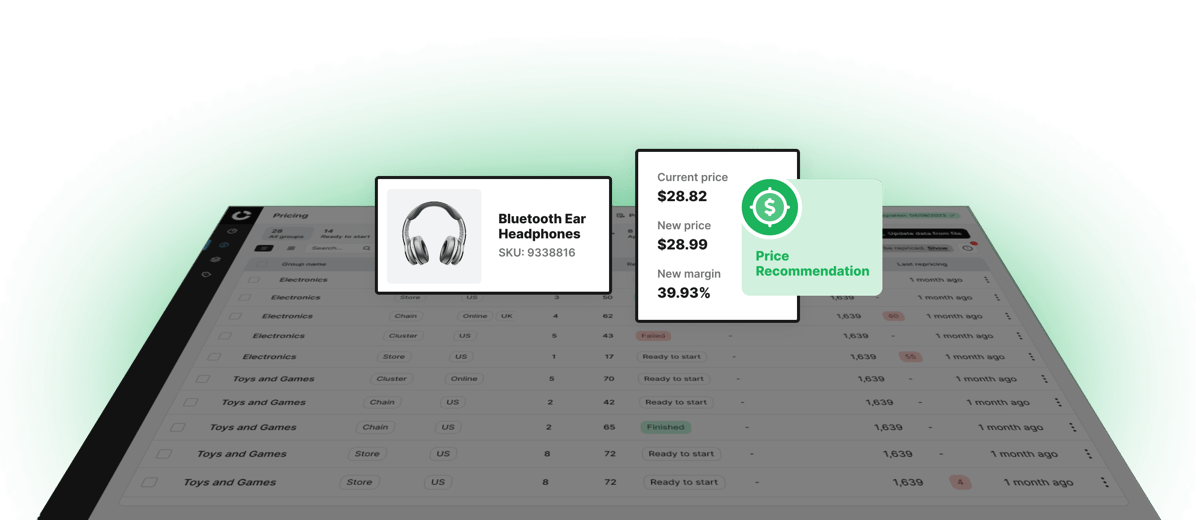
Tools like Competera can automate cost-plus pricing calculations, whether for margin or markup rate, to recommend prices that fit a retailer’s business needs. They can also use cost-plus pricing as part of broader pricing strategies to protect profit margins and boost revenue.
Cost-plus pricing examples
Cost-plus pricing yields different selling prices and margins because cost structures and markup rates vary across retail categories and segments, though the underlying formula is fixed. The table below applies the same calculation to three common product types.
|
Product type |
Cost |
Markup |
Selling price |
Margin |
|
Grocery consumables |
$2 |
20% |
$2.40 |
16.7% |
|
Consumer electronics |
$180 |
45% |
$261 |
31% |
|
Fashion and apparel |
$25 |
120% |
$55 |
54.5% |
Grocery consumables
Grocery consumables typically have a thin markup under cost-plus pricing because profit comes from volume, not margin per unit. For example, a $2.00 item marked up 20% sells for $2.40, yielding a 16.7% margin. High-velocity categories like packaged food run this way since thousands of units are sold and a wide margin per item isn’t necessary.
Consumer electronics
Consumer electronics with cost-plus pricing typically carry a mid-range markup to reflect higher unit costs and shorter product lifecycles. For instance, a $180.00 cost item with a 45% markup sells for $261.00, resulting in a 31% margin. This markup must also account for depreciation risk, since electronics lose relevance quickly. If stock remains unsold, profit margins may erode before inventory is cleared.
Fashion and apparel
Fashion and apparel often have the widest markup because unit costs are low relative to perceived value. A $25.00 item marked up 120% sells for $55.00, resulting in a 54.5% margin. This wide margin gives retailers room to mark down later in the season without falling below cost.
Advantages of cost-plus pricing
The cost-plus pricing strategy brings retailers straightforward calculations, consistent application, and traceable cost recovery. These characteristics make it useful when retailers need a controlled pricing baseline or a defined cost floor without requiring extensive demand data.
Simple to calculate and implement
Cost-plus pricing is simple to calculate and implement, requiring only two inputs: cost and markup percentage. Enterprise retailers can avoid building complex demand models or pricing rules.
This approach is suitable for baseline pricing, stable categories, and situations where cost recovery carries more weight than frequent market adjustments.
Consistent and auditable
The cost-plus pricing model creates a traceable relationship between cost, markup, and selling price. Retailers can reconstruct how any price was set and see which markup policy produced results without any guesswork.
That traceability can support pricing governance across large organizations. Finance teams can review cost recovery, category teams can apply approved markup policies, and pricing teams can document why a baseline price was established.
Guarantees margin coverage on each unit
Cost-plus pricing supports planned unit margin when the underlying cost is accurate and the product sells at the set price. The markup establishes a defined amount above the cost base, giving retailers a minimum contribution target.
That protection doesn’t establish whether the resulting price produces the best outcome. A different price may support stronger volume, revenue, or category-level margin depending on customer demand and price sensitivity.
Limitations of cost-plus pricing
The limitations of cost-plus pricing stem from its lack of input on demand, customers, and competition. The formula determines the markup over cost, but does not estimate how customers will respond to the resulting price.
Ignores what customers are willing to pay
Cost-plus pricing doesn’t measure willingness to pay, since the price is set entirely from internal cost data. Two products with identical costs can support different prices when customers perceive value differently or have different levels of price sensitivity.
Price elasticity data gives retailers a way to quantify part of that response. It helps teams assess whether a price change will increase or decrease demand enough to improve sales volume and profit margin.
Ignores competitive context
Competitor prices are not accounted for in the cost-plus pricing formula. A calculated selling price can sit above or below comparable products as the formula never references what a competitor charges for the same or similar product.
The issue is particularly relevant for KVIs and other products that influence price perception. A retailer using cost-plus pricing in a category with several close substitutes risks pricing itself out of consideration on products customers actively compare.
Rewards inefficiency
A higher production or acquisition cost may produce a higher selling price under the same markup rule, even when the market does not support the increase.
There’s no built-in incentive to negotiate better supplier terms or streamline logistics, since cost increases are simply passed on to the customer. Over time, this dynamic can mask cost problems that a retailer might otherwise catch and fix.
Does not adapt to demand changes
Cost-plus pricing doesn’t respond automatically to demand changes, whether it’s a seasonal spike, a viral trend, or declining interest. The same cost and markup set the same selling price, regardless of demand fluctuations.
This creates missed opportunities in either direction. Strong demand may support a different price, while weak demand or excess inventory may require an adjustment to protect sell-through.
|
Advantages |
Limitations |
|
Simple to calculate |
Ignores customer willingness to pay |
|
Consistent and easy to audit |
Ignores competitor pricing |
|
Guarantees margin coverage |
Rewards inefficiency and complacency |
|
Requires minimal data and inputs |
Doesn't respond to demand shifts |
Variations of cost-plus pricing
Variations of cost-plus pricing differ mainly in terms of which costs are included and what the selling price is expected to cover. The appropriate method depends on the commercial decision. A retailer setting a long-term base price may need a broader cost view than a team evaluating the economics of selling one additional unit.
Full-cost pricing
Full-cost pricing is a cost-plus pricing variation that adds a markup to fixed and variable costs, such as freight, warehousing, and operating expenses. It's the most common version because it ensures every cost line gets covered by the selling price before any profit is counted.
Marginal cost-plus pricing
Marginal cost-plus pricing applies the markup rate only to variable costs, leaving fixed costs covered separately across the wider portfolio. Retailers use this on clearance items or promotional SKUs where the goal is moving inventory and short-term margin recovery, without pricing a product out of the market entirely.
Contribution-margin pricing
Contribution-margin pricing deducts the variable costs and focuses on how much the remaining amount can cover fixed costs. This helps retailers compare how products support broader category economics.
When cost-plus pricing makes sense
Cost-plus pricing works best when costs are predictable, pricing is easily auditable, and retailers lack visibility into demand or competitive conditions. It also determines the cost floor when retailers use other strategies to set the selling price.
Useful applications include scenarios like:
- Private-label and exclusive products with no close comparisons.
- Early-stage retailers with limited pricing or data infrastructure.
- Categories with volatile input costs, where margin protection is the priority.
- New product launches with no sales history to build a demand model from.
Where cost-plus pricing falls short for enterprise retailers
Cost-plus pricing falls short when numerous pricing decisions must account for different product roles, local demand conditions, competitor positions, and commercial objectives. A uniform markup cannot represent all of those differences.
Scaling
Applying the same pricing logic on different products doesn’t hold up once a retailer starts managing thousands of SKUs across multiple locations and channels. Different SKUs can have distinct demand characteristics or commercial roles, and may need different pricing methods.
A national retailer, for example, may have a single acquisition cost per item while customer demand differs significantly between locations. Applying one markup produces the same baseline regardless of those differences.
Margin recovery
The margin recovery problem is the difference between achieving a fixed markup and finding the price that best supports the retailer’s price objective. The cost-plus pricing method can calculate the first, but has no mechanism for estimating the second.
Price optimization models close that gap, evaluating demand elasticity, competitor movements, and inventory position together, rather than treating cost as the only variable that matters.
Competitor prices
Cost-plus pricing ignores competitor prices for the same product, which can be a liability in crowded categories. A retailer can maintain its target markup while pricing above or below comparable products, potentially weakening price perception or sacrificing margin.
Cost-plus pricing cannot distinguish between these situations because the same cost and markup inputs produce the same pricing logic, regardless of competitive context.
What enterprise retailers use instead, or alongside cost-plus pricing
Enterprise retailers may use demand-based and value-based pricing to fill the gaps that cost-plus pricing strategy leaves open. Most run all three models simultaneously, not just picking one for the entire assortment.
The appropriate mix varies across an assortment:
- A highly visible KVI may require close competitive positioning.
- A differentiated or less price-sensitive product may provide more room for margin.
- Inventory pressure, lifecycle stage, and channel can also change the appropriate strategy.
Cost-plus pricing can remain part of the decision-making process without determining final prices. A cost floor protects the retailer’s boundaries, while demand, competitive position, customer value, and product role provide additional context for pricing decisions.
How Competera Pricing Platform supports the move beyond cost-plus pricing
Competera Pricing Platform helps enterprise retailers use cost as a pricing constraint while incorporating other influential signals into the final pricing decision. This gives cost a defined role without requiring fixed markups.
Demand elasticity modeling across 20+ factors
Competera models costs alongside over 20 demand-impacting factors to estimate how demand responds to price. These inputs include:
- Product roles and relationships
- Lifecycle stage
- Price sensitivity
- Margin drivers
- Location and channel differences
Price recommendations based on these factors reflect actual customer behavior, not just what a cost-plus pricing formula assumes.
What-if simulation before price changes go live
What-if simulations let enterprise retailers test price changes against forecasted revenue, profit margin, and volume impact before they reach consumers. Teams can compare cost-plus baselines with alternative prices and choose one that fits the current business goal.
Testing these outcomes before execution gives retailers more information before committing to a price change.
Business guardrails enforce cost floors automatically
Enterprise retailers can apply price boundaries and business constraints every pricing cycle without manual reviews. Cost floors can remain part of the decision when demand and competitive signals influence the recommended price.
Teams retain control over pricing boundaries, approvals, and overrides while allowing recommendations to move within those defined constraints.
Daily AI-driven recommendations across the full assortment
Competera generates and refreshes AI-driven pricing recommendations across the portfolio daily. Prices can be optimized at store, cluster, and channel levels, giving the system room to account for differences that one cost-plus pricing rule cannot represent.
With contextual AI, the solution recommends prices with:
- 95%+ forecast accuracy
- 3–7% revenue growth
- 2–5 percentage-point margin uplift
- 50–70% efficiency gains in pricing team workload
The pricing maturity path
The pricing maturity path is a five-stage framework, moving through:
Stage 1: cost-plus
-
Price is derived from the cost-plus pricing formula.
-
Supports cost and margin control, but ignores market and demand signals.
Stage 2: Manual market-driven
-
Teams manually benchmark competitors and adjust prices.
-
Involves cost and competitive data, but data gathering and execution are labor-intensive.
Stage 3: Automated rule-based
-
Competitive rules manage pricing within margin constraints.
-
More scalable with web scraping and automation tools, but lacks demand context.
Stage 4: Optimized customer-centric
-
Price recommendations come from value-based and competitive pricing logic.
-
Portfolio-level profit margin and revenue optimization.
Stage 5: Personalized
-
Prices and offers are set by customers or segments with AI and machine learning engines.
-
The goal shifts toward maximizing willingness to pay and customer lifetime value (CLTV).
Conclusion
Cost-plus pricing earns its place as the simplest way to set a price. The trouble starts when a retailer tries to run an entire enterprise catalog on a formula that only ever looks at cost. Competitors move, demand shifts by season and by SKU, and customers' willingness to pay rarely lines up with a fixed markup percentage.
Contact us to understand how Competera maintains cost-plus pricing as part of its overall price optimization efforts while using richer signals to determine the final selling price.

.png)