



Key takeaways
- Sell-through rate measures how much of the inventory a retailer receives actually sells over a set period. It is calculated by dividing units sold by beginning inventory, then multiplying by 100.
- There is no universal "good" number. A healthy rate depends on price point, product type, and the time window, so a seasonal drop and an evergreen staple are judged very differently.
- A low sell-through rate usually has a fixable cause: a mispriced product, softening demand, over-buying, or weak promotion and placement.
- Conversely, a high rate is not automatically good news. Rapid stockouts can mean underpricing or under-purchasing inventory, both of which signal missed revenue opportunities.
- Read as a pricing signal, sell-through rate tells retailers when to mark down, when to promote, and when there is room to raise prices.
What is sell-through rate?
Sell-through rate is the percentage of a retailer's stock that sells within a set period. For instance, if a retailer receives 100 units and sells 70 in a month, the sell-through rate is 70%. The number shows in one figure whether a product is priced right and selling as fast as planned, so retailers use it as a quick check on inventory and pricing health.
Why sell-through rate matters
Sell-through rate matters because it turns a stockroom full of separate buying and pricing decisions into one number a retailer can act on. A healthy rate means capital is not sitting idle in unsold stock, shelf space goes to products customers actually want, and the price is balanced: high enough to protect margin, low enough to keep stock clearing on schedule.
Getting that balance wrong is expensive: global retail research firm IHL Group estimated that inventory distortion (stock mismatched to demand) cost retailers $1.77 trillion in 2023, or 7.2% of total sales.
A rate that drifts too low or spikes too high signals early that something in the pricing or buying plan needs attention. That is why sell-through is one of the core pricing KPIs that retailers track: it protects margins without pushing prices beyond what shoppers will accept.
The sell-through rate formula
To calculate the sell-through rate, a retailer compares two numbers over a chosen period: the units in stock at the start and the units sold by the end. The sell-through rate is the percentage of that starting stock that sold. For example, a store that starts the month with 200 units and sells 150 by month-end has a 75% sell-through rate. We break down the formula and what the results mean below:
The formula
Things to note:
- Beginning inventory is the stock on hand at the start of the period, before any restocking.
- Units sold is what was sold during that same period.
- Multiplying by 100 turns the ratio into a percentage.
What the result tells you
The higher the percentage, the faster stock cleared. A low rate means the product is selling slower than planned, with cash tied up in unsold units. A mid-range rate means it is selling at about the pace it was bought. A rate near 100% usually means it sold out before the period ended, a sign of under-ordering or a price set too low. Because the same number can point to opposite problems, always read it against a target, not on its own.
One caveat: the formula assumes a fixed stock batch measured over a set period. If a retailer restocks mid-period, the beginning inventory no longer reflects all inventory available for sale. In that case, retailers typically measure the rate over a shorter window or calculate it relative to the total units available (beginning inventory plus units received).
For continuously replenished products, sell-through is less useful than inventory turnover, which is designed for stock that never resets.
How to calculate sell-through rate: worked examples
While the math is simple, retailers must choose the right timeframe to use the formula effectively. The sale period should match how the category sells. For instance, a fast-moving grocery item might be more appropriately measured within a week, while slow-moving furniture should be tracked across a full season. A window that's too long blurs separate selling cycles, while a window that's too short makes normal sales look like a shortfall.
Example 1: grocery consumable
Grocery consumables sell fast, get replenished constantly, and spoil, so sell-through is typically measured over a week or less. The stakes here differ from other categories: a low rate does not just tie up cash; it also runs against the shelf-life clock, turning unsold stock into markdowns or waste.
Take a yogurt line. A store opens the week with 400 units and sells 340, or (340 / 400) x 100 = 85%. Because it restocks, deliveries have to be counted: if it received 300 more midweek and sold 500, the base is 400 plus 300, giving (500 / 700) x 100 = 71%, not the 125% that dividing by opening stock alone would produce.
For perishables, sell-through should indicate whether stock clears before its shelf life ends. If a line reliably sells through in ten days but expires in seven, the order is too big, no matter how healthy 71% looks.
Example 2: health and beauty product
Health and beauty splits into two patterns, and sell-through is read differently for each. Core lines like a daily moisturizer or a staple shampoo sell steadily, so a moderate rate is healthy. For instance, a retailer stocking 1,000 units and selling 600 in a month has (600 / 1,000) x 100 = 60%, with the rest set to clear before the next order.
New launches are the opposite. Beauty runs on newness and scheduled planogram resets, where retailers reallocate shelf space to add, drop, or expand product lines. A new launch must prove itself before that next reset: strong early sell-through earns it a permanent slot, while a weak start gets it dropped.
Shelf life intensifies the pressure. Slow-moving beauty products are inventory on a countdown, prompting retailers to monitor sell-through strictly for both fresh launches and aging batches.
Example 3: home furnishings
As a high-ticket, low-volume category tied to seasonal cycles, home furnishings are typically measured for sell-through over a full season or quarter. For example, a retailer buys 300 armchairs for spring and sells 270 by the end of the season. The STR is then (270 / 300) x 100 = 90%.
In a slower category, a 90% sell-through rate signals a problem rather than a victory. Furniture lead times are long, so the retailer could not have chased that demand mid-season with a reorder, and selling 90% likely means the armchair was under-bought, priced too low, or both, leaving money and demand on the table.
On the other hand, a low rate carries the opposite problem. Since new collections land on a fixed calendar (roughly February and August), leftover stock has to be cleared before then, and bulky furniture is expensive to store while it waits.
Either way, the season's sell-through is really an input to the next buy and its opening price, not just a scorecard for the season that ended.
What is a good sell-through rate?
A good sell-through rate depends entirely on what is being sold and over what period, so no single number applies across retail. Three things determine what's healthy: how fast the category naturally sells, the product's price point, and the length of the measurement window.
The ranges below are commonly cited by category and make useful starting references, but they are conventions rather than hard benchmarks:
|
Retail category |
Commonly cited range |
Interpretation |
Pricing signal |
|
Grocery and consumables |
Around 85%+ weekly |
Very high, fast turnover, measured weekly or shorter |
Falling short risks spoilage; discount or clear early |
|
Health and beauty |
Around 60–80% monthly |
Steady on core lines, higher and faster on new launches |
A weak launch rate signals a price or placement fix before the next reset |
|
Home furnishings |
Around 40–60% seasonal |
Healthy for a slow, big-ticket category over a season |
A rate near or above 80% suggests underpricing or under-buying; raise on the next buy |
|
Consumer electronics |
Around 50–70% per model cycle |
Moderate, but racing product obsolescence |
Behind pace means markdown before the next model drops residual value |
|
Apparel and fashion |
Around 60–70% at full price per season |
Full-price sell-through before markdown is the number that matters |
Below target forces earlier, deeper discounts |
Commonly cited sell-through ranges by retail category. These reflect general industry convention rather than measured benchmarks and shift with the measurement window and product life cycle. Use them as starting references and calibrate against actual sales history.
Category-specific benchmarks
Category norms track how fast each one sells and how much a delay costs.
- Grocery and consumables. The fastest-moving category, where healthy means clearing most stock within a week. Because the products spoil, a dip prompts early discounting rather than waiting.
- Health and beauty. Core lines sit comfortably mid-range each month, but new launches are judged higher and faster, since a weak early rate costs them shelf space at the next reset.
- Home furnishings. A slower, big-ticket category where a moderate seasonal rate is healthy. Here, an unusually high rate is a warning sign, pointing to missed margin and underpriced inventory rather than a clear win.
- Consumer electronics. Measured against product release cycles rather than the calendar, since next-generation launches quickly erase the value of older models. The priority is clearing inventory before the update lands, even if it requires accepting a lower margin.
- Apparel and fashion. Measured by how much stock sells at original price before discounting begins. Reaching full-price sales goals protects margins; missing them requires earlier, heavier markdowns to clear seasonal inventory.
The sell-through rate and product life cycle
A good sell-through rate also moves with a product's life cycle stage, not just its category. Expectations shift across each phase: a new launch must sell quickly to prove demand, a mature staple needs steady volume, and an end-of-life product is judged by how cleanly it clears before its replacement arrives.
The same 50% can be healthy at one stage and a problem at another, which is why sell-through targets are set alongside life cycle pricing rather than held constant over a product's life.
What causes a low sell-through rate?
A low sell-through rate is a symptom, not a cause, and it usually traces to one of four things: the price, a shift in demand, an oversized buy, or weak promotion and placement. We break down all four below.
Pricing misalignment
Pricing misalignment is one of the most common causes of a weak sell-through rate. When an item costs more than what shoppers expect or what competitors charge for an equivalent product, buyers look elsewhere and inventory stalls.
Price is also the quickest factor to adjust, so it is one of the first things retailers should check for when a rate is low. Even a small correction can restart sales without changing the rest of the assortment.
Demand shift
Sometimes the price is right, but demand has simply moved. Tastes change, a competitor launches something newer, or the economy tightens, all between the moment stock was ordered and the moment it reached the shelf.
If the order was sized for demand that no longer exists, sell-through falls regardless of price. Sharper demand forecasting narrows this gap by sizing orders to where demand is heading, not where it was.
Over-buying
A low rate can also mean demand was fine and the order was simply too big. An oversized initial purchase leaves more inventory than regular demand can absorb, making the sell-through rate appear weak even when sales remain steady. Holding that surplus carries a real cost, as the American Productivity & Quality Center (APQC) notes that inventory carrying costs add up to a sizable percentage of total stock value each year.
Regardless of steady demand, that extra stock still needs to move. That usually takes a deliberate discount pricing strategy to clear the surplus without cutting margin on the rest of the range.
Promotion and placement issues
A product can be priced right, stocked in the right quantity, and still stall if shoppers never notice it. Poor shelf position, a buried spot in online search results, or a launch with no promotional support will suppress sell-through. In this case, the fix is exposure, not price: better placement or a targeted promotion often recovers the rate on its own.
Sell-through rate as a pricing decision input for enterprise retailers
For enterprise retailers, sell-through rate is an actionable metric, not just one to report. Read against a target, a rate that is off points to a specific move: mark down, promote, or raise the price. The right move depends on why the number is where it is.
When sell-through signals a markdown is needed
A markdown is needed when sell-through stays low and time is running out. This is the end-of-life case: a seasonal line, an aging model, or stock that must clear before new inventory lands.
A temporary promotion will not fix it. A promotion drops the price, then restores it. However, this product will not sell at full price again, so it needs a permanent cut. A markdown pricing decision lowers the price for good, clearing stock and freeing up shelf space and cash. Aim for the smallest cut that still moves the inventory in time.
When sell-through signals a promotion is needed
A promotion is needed when sell-through is soft, but the product still has a future at full price. Unlike a markdown, a promotion is temporary. It lifts demand for a set window, then the price returns to its level. It suits a product that is selling below target for a fixable reason, such as low awareness or a slow start. A well-timed promotional pricing strategy can reset momentum without permanently lowering the price or the product's perceived value.
When high sell-through signals a pricing opportunity
A high sell-through rate also provides an actionable signal, but one that points toward underpricing rather than overstocking. When a product sells out early or clears well above target, it was probably priced too low. Demand could have supported a higher price, so the retailer earned less per unit than it could have.
The correct move is to raise the price on the next order or restock at a higher price where lead times allow. Selling out fast may feel profitable, but an empty shelf turns every remaining shopper into a missed sale.
How Competera Pricing Platform uses sell-through rate
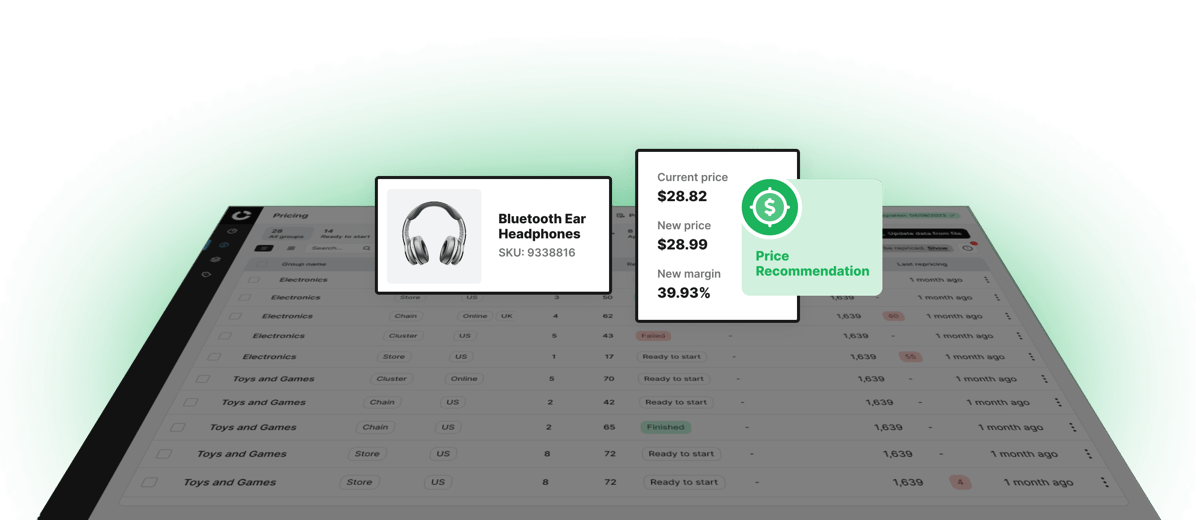
Competera Pricing Platform uses sell-through rate as a live input for its pricing recommendations, not as a metric checked after the fact. For every product, it compares the rate against target and recommends the right move: mark down, promote, or hold. It does this continuously, across the entire assortment.
Sell-through-informed markdown recommendations
When a product's sell-through falls behind target, Competera flags it early. It recommends a markdown before the shortfall becomes a clearance problem. The platform predicts the outcome of a price change with 95%+ accuracy, so it can recommend the smallest markdown that still clears stock in time, protecting margin as it comes down. These markdowns are timed and sized across the assortment through retail promotion optimization.
Promotion recommendations calibrated to sell-through targets
When a product is selling below target but remains viable, Competera recommends setting a promotion to a specific sell-through goal. It calibrates the depth and timing to hit that goal without discounting deeper than needed. It simulates the promotion first, so the retailer can see the expected sales lift and margin cost before committing. This is part of Competera's promo management solution.
Continuous monitoring across the full assortment
Tracking a full assortment of tens of thousands of products is hard. Competera monitors sell-through across every product, store, and channel at once, refreshing AI-driven recommendations daily. Competera's pricing analytics software ensures that no product drifts below target unnoticed, and no fast seller stays underpriced for long.
Conclusion
Sell-through rate is a valuable signal for retailers. Read against a target, it tells a retailer what to do next: mark down a laggard, promote a soft but viable line, or raise the price on a product that keeps selling out.
Used this way, it breaks the usual trade-off between clearing stock and protecting margin. Most retailers assume they have to give up one to get the other, but acting on sell-through, product by product, lets them do both: clear what needs to move while holding price where demand still supports it.
At the scale of a full assortment, Competera Pricing Platform measures every product's sell-through against target and turns it into an AI-driven pricing recommendation across every store and channel.
Talk to an expert to see how Competera turns sell-through into pricing decisions across your own assortment.

.png)