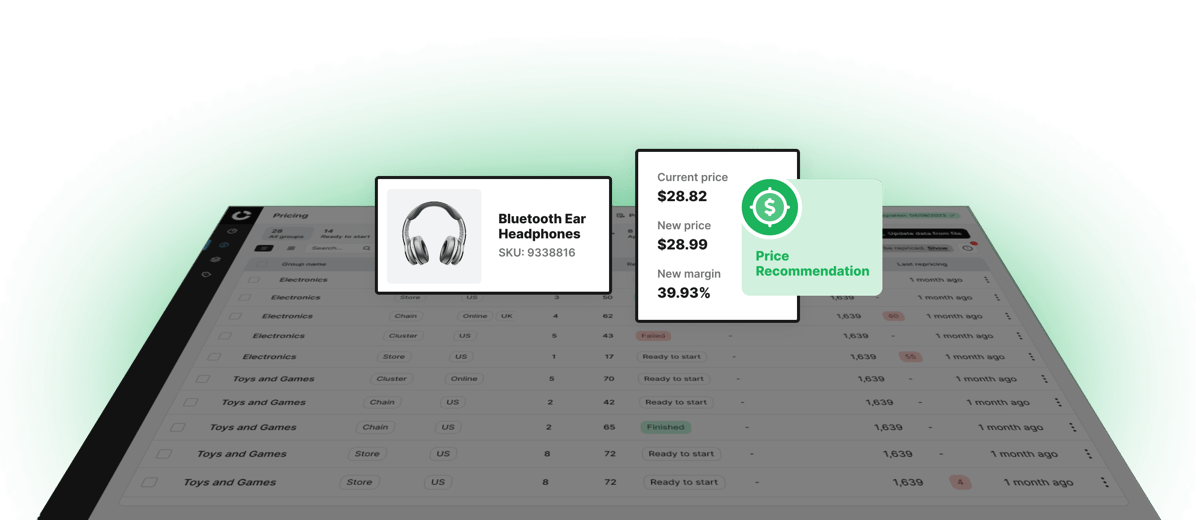




Finding the right price for every product — across multiple SKUs and channels — is one of the harder operational challenges in enterprise retail. AI price optimization addresses this by leveraging machine learning to continuously calculate and recommend prices that balance revenue, margin, and customer demand at scale.
Discover how AI pricing works, which pricing models enterprise retailers use, and what to look for when evaluating AI pricing software solutions in this blog.
What is AI price optimization?
AI price optimization uses machine learning to recommend prices that align with business goals. It replaces static rules and manual competitor checks with a system that continuously learns from sales history and live market signals.
Traditional pricing tools typically compare your prices against competitors and apply fixed rules. In contrast, AI pricing tools draw on a much wider set of inputs, such as:
- Competitive pricing analysis.
- Price elasticity of demand across SKUs and categories.
- Buyer behavior.
- Real-time market signals.
- Historical sales data and inventory levels.
AI price optimization is often conflated with dynamic pricing, but the two are not the same. Dynamic pricing reacts to predefined rules or market triggers, whereas AI price optimization is predictive, forecasting likely outcomes before prices go live.
How AI price optimization works: the engine behind the prices
AI price optimization works by evaluating demand drivers and predicting how customers are likely to respond to different pricing scenarios.
Unlike rule-based retail price optimization tools that follow established hard rules, AI pricing engines, such as Competera, evaluate pricing decisions in context. They continuously process large volumes of data across products, stores, channels, and regions to recommend prices that support specific business objectives, including:
- Internal factors
- KVI identification
- Basket behavior
- Product relationships
- Margin drivers
- Promotion impact
- External factors
- Competitor activity
- Seasonality
- Inflation and buying power
- Weather patterns
- Channel factors
- Country differences
- Channel differences
- Store-format differences
- Regional cluster differences
- Distribution factors
Instead of publishing prices and measuring results afterward, enterprise retailers can evaluate potential outcomes before making a pricing change. For example, what-if pricing simulations allow retailers to compare multiple pricing strategies and estimate their effect on revenue, margin, and sales volume.
This gives commercial leaders a stronger basis for deciding whether to launch a promotion, adjust prices within a category, or respond to competitor activity.
AI pricing models enterprise retailers use
Enterprise retailers usually combine several retail price optimization models, rather than relying on a single approach. The right model depends on the product, category, and business objective, and AI price optimization enables you to determine the best approach for each product group.
Demand-based pricing
Demand-based pricing sets prices according to real-time and forecasted customer demand. Beyond historical sales data, AI models evaluate price sensitivity across your portfolio to gauge customer willingness to pay, so prices reflect actual demand dynamics.
Retailers use this model to capture additional margin when demand is strong and protect sales volume when demand begins to soften. As machine learning automates demand forecasting, pricing recommendations stay current with changing market conditions.
Competitive pricing
This model positions your prices relative to competitor pricing. Many retailers adopt competitive positions through years of pricing decisions. AI pricing surfaces those gaps quickly and helps teams determine whether they are underpriced, overpriced, or correctly positioned.
A BCG survey in 2024 illustrates one example where a grocery retailer identified categories priced 20–30% below its primary competitor. By selectively adjusting those prices, the retailer improved margins with little impact on sales volume.
Retailers also need reliable competitive intelligence to support those decisions. Competera Competitive Intelligence Data, powered by AI, tracks 119 million data points each month across 34 markets. This gives pricing teams access to current competitive market information without manual tracking.
Elasticity-based pricing
Price elasticity of demand measures how customer demand responds to price changes, which can vary by product, channel, and category. Retailers use elasticity-based pricing to understand where prices can increase without reducing sales volume and where stronger price competitiveness is needed.
Advanced AI pricing tools like Competera go beyond price elasticity. They account for competitive elasticity, cross-product relationships, seasonality, and promotional history, building a more complete picture of demand for enterprise retailers.
KVI pricing
KVI pricing, or key value item pricing, focuses on the products that will most influence how customers perceive your overall price competitiveness. These are the items shoppers use to benchmark value across retailers.
Customers use KVIs as reference points when deciding whether a retailer offers good value overall. As these products strongly influence price perception, retailers often prioritize them while protecting margin across the rest of the assortment.
Promotional and markdown pricing
Promotional and markdown pricing determines the discount depth of specific products and when to apply the discount. Since promotions are often where retailers lose margin unnecessarily, they are one of the most critical opportunities for retail price optimization.
This is also where retailers often lose the most margin. Blanket discounts, poorly timed markdowns, and indiscriminate promotions can erode profitability and reduce demand over time. AI pricing software solutions forecast likely promotional outcomes, so you can avoid these pitfalls.
Optimizing promotions and discounts with AI pricing
AI pricing solutions like Competera identify which promotions actually increase profitable demand and simulate the full impact of promotions before they launch. That visibility is what separates strategic promotional planning from reactive discounting.
They decide which products to discount, how much, and when, based on:
- Cannibalization modeling flags related products that are likely to see reduced full-price sales.
- Price sensitivity segmentation identifies which customers actually need a discount to convert.
- Promotional lift simulations show expected incremental demand at different discount depths.
Whether the goal is to drive traffic or protect margins, pricing teams can plan promotions with greater precision. This protects brand value while directing your organization’s spending towards areas that drive real returns.
The role of human-in-the-loop pricing with AI
Human-in-the-loop pricing ensures that pricing teams stay in control while AI handles the heavy lifting of generating and explaining recommendations.
Enterprise retailers are reluctant to hand off pricing decisions to systems they can't interrogate. They need recommendations they can understand, review, and authorize. Black-box AI, which generates outputs without transparent reasoning, can stall adoption by removing accountability.
AI pricing software solutions built with explainability solves this by making the logic visible at every step. A practical human-in-the-loop pricing workflow looks like this:
- AI generates a recommendation.
- Pricing teams review the logic.
- Business rules and margin constraints are applied.
- Pricing teams make the final decision to approve and publish the price.
Competera supports this approach through explainable recommendations, approval workflows, and business guardrails. Combined with pricing automation, retailers can reduce manual repricing work by 50–70% while maintaining control over pricing decisions.
How to evaluate AI price optimization software for enterprise retail
Evaluating AI price optimization software means determining whether a platform holds up under the specific conditions your business runs on, not whether it performs well in a controlled demo. An ideal AI price optimization software should help retailers make better pricing decisions faster.
- Accuracy: Does it consistently produce profitable and volume-enhancing prices?
- Data integration: Can it merge internal and external sources like competitor price analysis and supplier data?
- Automation: Does the AI pricing solution empower your team without taking full control away?
- Portfolio optimization: Can it manage pricing across broad categories as Competera does?
- Transparency: Can your team understand and trust its pricing decisions?
- Speed: How quickly does it deliver tangible results?
- What-if pricing simulation capabilities: Does it enable your team to simulate pricing scenarios with probability rates before going live?
- Demand elasticity modeling: Can it model more than 20 pricing and non-pricing factors, or just a basic price vs. volume relationship?
- Granularity: Can retail price optimization happen at the store, cluster, and channel levels?
The Competera Pricing Platform supports AI pricing recommendations at store, cluster, and channel levels, reflecting local competitive landscape and customer willingness to pay. This builds the kind of consistent price perception that keeps customers coming back.
On top of that, Competera can scale to a new sales channel or region in one week and provide competitive pricing intelligence that tracks 34 markets and refreshes every 15 minutes. You get to deploy AI pricing and capture accurate market data as soon as possible.
What enterprise retailers achieve with AI price optimization: outcomes and benchmarks
AI price optimization improves campaign targeting, boosts customer retention, and aligns prices with market demand dynamically. This makes pricing a central lever throughout the customer lifecycle.
The most significant gains come when retailers embed AI price optimization into day-to-day operations rather than treating it as a standalone tool. According to BCG, AI pricing initiatives can boost both revenue and gross profit by 5–10%.
Competera reports customer outcomes that include:
- 3-7% revenue growth.
- 2-5 percentage points of margin uplift.
- 50-70% reduction in manual effort for pricing teams.
- 30% increase in customer lifetime value.
Retailers that combine demand elasticity modeling, competitive pricing intelligence, pricing simulations, and human oversight with AI pricing are better positioned to respond to market changes while protecting both margin and customer trust.
Contact us to explore how AI price optimization with Competera can help your team improve revenue, margin, and pricing efficiency.

References
1. Anta Callersten, J., Bak, S., Xu, R., Kalthof, R., & Bradley, S. (2024, April 16). Overcoming retail complexity with AI-powered pricing. Boston Consulting Group.
2. Bak, S., Kalthof, R., Vincent, J., Lee, P., Schwartz, B., & Rastogi, A. (2024, November 15). Inflation has changed consumers. It's time to rethink pricing. Boston Consulting Group.
.webp)