



TL;DR
- An omnichannel pricing strategy coordinates pricing across stores, eCommerce sites, mobile apps, and marketplaces to support profitability, promotions, inventory conditions, and customer experience across every sales channel.
- Enterprise retailers usually choose between uniform, channel-differentiated, or a contextual dynamic pricing approach depending on factors such as assortment overlap, competitive pressure, fulfillment economics, and customer expectations.
- The biggest operational challenges are pricing logic that does not adapt, inconsistent logic across systems, and siloed data that limits visibility across channels and regions.
- AI-driven pricing improves omnichannel execution through unified pricing data, channel-specific demand modelling, pricing simulations, and automated deployment with business guardrails.
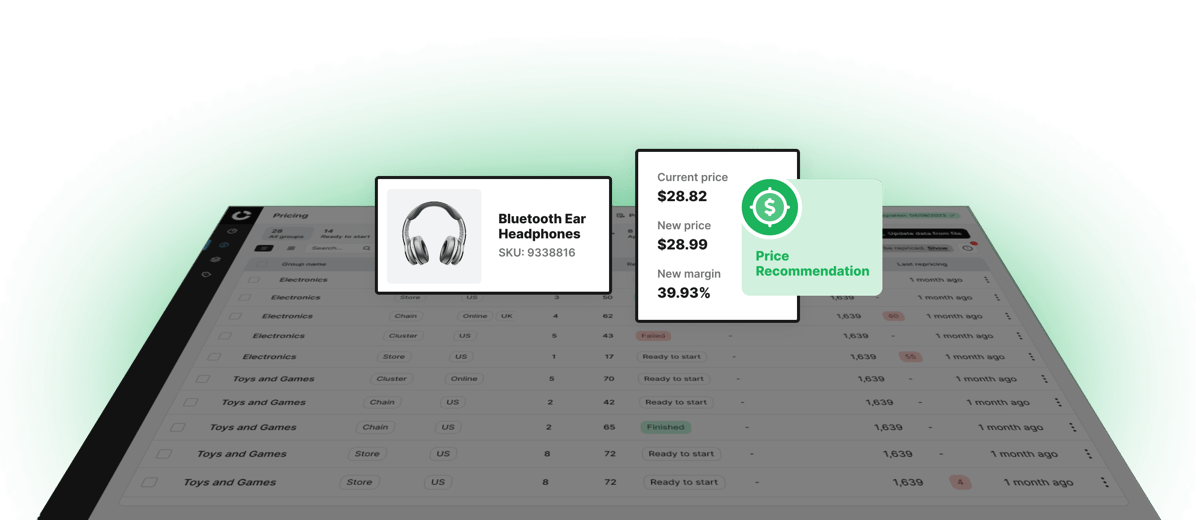
- Competera’s AI-driven customer-centric pricing platform combines optimization groups, anchor management, smart product segmentation, reusable pricing campaign templates, and omnichannel pricing intelligence to help enterprise retailers scale consistent pricing decisions across their entire sales ecosystem.
What is omnichannel pricing strategy?
Omnichannel pricing strategy is a retail pricing approach that helps to keep pricing decisions coordinated across stores, eCommerce, mobile apps, marketplaces, and other sales channels.
The objective of this strategy is not to make every price identical, but to maintain consistent pricing logic, customer price perception, and business objectives across every channel while helping retailers to adapt to different demand, competition, and fulfillment conditions.
Why omnichannel pricing is different from single-channel pricing
The difference between omnichannel pricing and single-channel pricing is that single-channel pricing optimizes prices for one sales environment, while omnichannel pricing strategy coordinates pricing decisions across all customer touchpoints.
Single-channel pricing is a retail pricing approach that is focused on optimizing prices for a single sales environment such as a physical store, an eCommerce site, or a marketplace. An omnichannel pricing strategy, however, operates differently by taking into account how shoppers can move between stores, websites, mobile apps, and marketplaces before making a purchase. For example, a price a customer sees online in the morning can be compared with an in-store shelf price later the same day.
This level of visibility is what makes omnichannel pricing more comprehensive. It helps retailers to maintain pricing logic that supports profitability, promotions, fulfillment costs, and customer experiences across every touchpoint without creating confusion or affecting customer trust.
The three omnichannel pricing approaches
Retailers do not all apply omnichannel pricing in the same way. In practice, most enterprise retailers usually adopt one of three omnichannel pricing methods, each of which provides a different balance between pricing consistency, operational flexibility, and margin control. The choice of channel pricing strategy is usually dependent on factors such as assortment overlap, competitive intensity, fulfillment economics, promotional structure, and customer expectations.
|
Omnichannel pricing approach |
Definition |
Advantage |
Limitation |
Best-fit retailer type |
|
Uniform pricing |
The same price is maintained across stores, eCommerce, mobile apps, and marketplaces. |
Simple to manage and strengthen a consistent brand perception. |
Reduces flexibility to respond to channel-specific costs, competition, or demand conditions. |
Retailers with highly standardized assortments and strong brand positioning. |
|
Channel-differentiated pricing |
Pricing varies by channel based on competition, fulfillment costs, customer behavior, or promotional strategy. |
Improves margin control and allows faster response to market conditions. |
Requires stronger governance to avoid customer confusion and channel conflict. |
Large retailers operating across stores, eCommerce, marketplaces, and regional fulfillment networks. |
|
Contextual dynamic pricing |
In dynamic pricing, prices are optimized continuously using demand signals, competitive data, inventory conditions, product roles, and channel context. |
Balances competitiveness, profitability, and customer value at scale. |
Requires reliable data, pricing intelligence, and coordinated execution across channels |
Enterprise retailers managing large assortments, frequent repricing, and complex omnichannel operations. |
Why omnichannel pricing is hard to execute at scale
Omnichannel pricing is hard to execute at scale because it requires that retailers keep their prices, promotions, and pricing decisions aligned across stores, eCommerce sites, mobile apps, marketplaces, and regional fulfillment networks while managing thousands of SKUs (stock-keeping units) and frequent pricing updates.
As retail operations expand, maintaining coordination, visibility, and responsiveness across every channel becomes increasingly demanding. What works effectively in a limited number of sales environments often presents new difficulties when a higher level of synchronization is required to support pricing decisions across thousands of products, multiple customer touchpoints, and continuously evolving retail operations.
Static pricing rules cannot keep pace with channel complexity
Static pricing rules are usually built around fixed conditions such as competitor price matching, margin thresholds, or scheduled promotions. Omnichannel pricing, however, requires decisions that can respond to changing demand, regional competition, inventory availability, fulfillment costs, and customer behavior across multiple channels.
As the number of channels increases and the market becomes more connected, fixed rules become harder to maintain consistently, as the rule that works for one sales environment may not be the right fit for another. The effect of having static pricing rules is slower pricing reactions and disconnected promotional execution. This is why many retailers adopt real-time pricing capabilities that keep their pricing decisions synchronized across fast-changing retail environments.
Disconnected systems create pricing silos
Pricing information is often spread across ERP (enterprise resource planning) systems, POS (point of sale) platforms, eCommerce tools, marketplace integrations, and promotional systems. When these systems do not share the same pricing data in real time, pricing teams can end up working with separate versions of current prices, promotions, or product availability.
As channel activity increases, these disconnected systems make it difficult to keep omnichannel pricing coordinated across every customer touchpoint. A price update may appear in one channel before another, while promotional changes may not be reflected consistently across stores, websites, and marketplaces. This causes reduced visibility and a weaker ability to maintain consistent pricing execution at scale.
Customer price visibility has changed the stakes
Price checking for customers used to require walking to the next store or waiting for a weekly flyer. However, due to innovation, price comparison now happens within seconds. A shopper standing in an aisle can immediately pull up a competitor’s app, check a price comparison site, or search for the exact product name and see what other retailers charge before deciding whether to buy. This shift has made pricing differences much easier for customers to notice.
The bigger issue is when a retailer’s own channels show different prices for the same product. A customer who finds a lower price on the retailer’s app while comparing it with the one he/she saw in a store can begin to question whether the prices they see are reliable. This loss of trust usually extends beyond that single transaction and continues to affect customer loyalty and future buying decisions. Enterprise retailers with large assortments and frequent price updates are generally more exposed because the risk of pricing mismatches increases as more SKUs and channels are added to the business.
The three challenges at the core of omnichannel pricing
The 3 main challenges that are associated with omnichannel pricing involve consistently keeping price logic responsive to changing market conditions, maintaining consistent pricing decisions across connected systems, and preserving visibility across large and rapidly changing product assortments.
Once retailers move beyond the initial setup of the strategy, omnichannel pricing becomes less about creating pricing rules and more about ensuring that those rules remain connected, consistent, and actionable across stores, eCommerce sites, mobile apps, marketplaces, and other customer touchpoints. These operational problems, in most cases, determine whether or not an omnichannel pricing strategy can deliver a coordinated and reliable pricing experience across every channel.
Pricing logic that does not adapt
Pricing logic becomes a problem in omnichannel pricing when the same pricing rules are applied across multiple channels without adjusting for the differences that may exist in demand, competition, inventory availability, fulfillment costs, and customer behavior.
When pricing logic cannot adapt to these changing conditions, enterprise retailers often struggle to maintain consistent pricing decisions across channels. This ultimately results in slower reactions to market changes, less effective promotions, and pricing outcomes that do not reflect the realities of each sales environment. When faced with this challenge, retailers usually employ dynamic pricing capabilities that allow pricing decisions to respond to channel-specific market conditions and business objectives.
Inconsistent logic across systems
A pricing strategy can be well designed but still produce inconsistent results when the systems used to manage and execute pricing do not apply the same rules or updates. This is commonly reflected when channels such as ERP, point-of-sale (POS), eCommerce, marketplace, and promotional systems handle pricing information differently, creating gaps between the price that was intended and the price that reaches the customer.
For enterprise retailers, these inconsistencies can make price optimization harder to execute even when the underlying strategy is good, because the pricing teams usually have to identify and correct discrepancies across systems.
Siloed data that limits visibility
Pricing decisions depend on data from multiple sources, including sales, inventory, competitor prices, promotions, and customer behavior. When this data is spread across separate systems, it becomes difficult for pricing teams to have a complete view of the factors that influence prices across sales channels. This makes it difficult to identify pricing opportunities, understand what is happening across channels, and make informed adjustments.
To address this challenge, retailers use competitive pricing analysis to help them bring external market data into the pricing process and make decisions with a much clearer view of the competitive landscape.

How AI-driven pricing closes the omnichannel execution gap
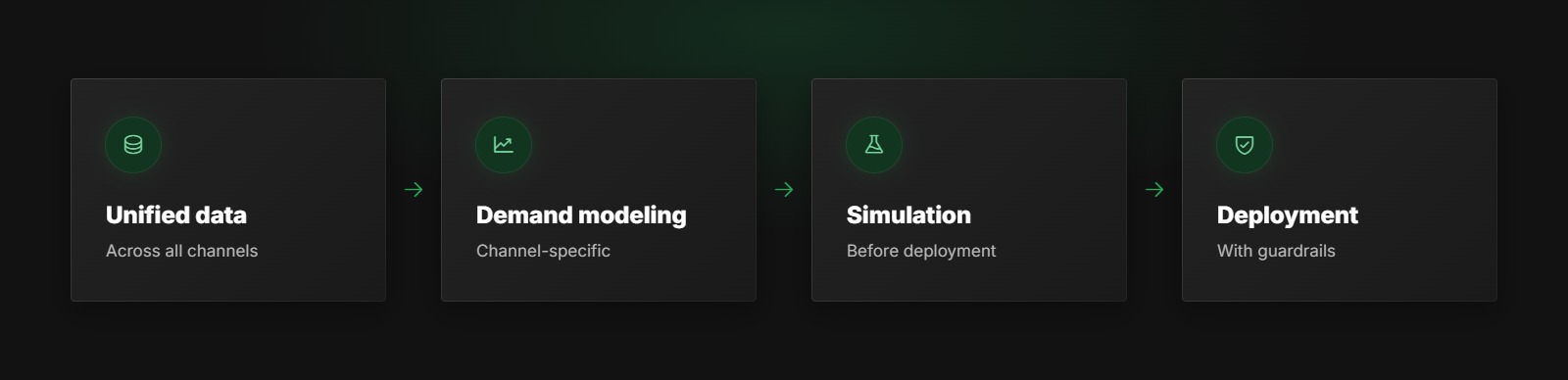
AI-driven pricing closes the omnichannel execution gap across retail operations by using unified pricing data, channel-specific demand modelling, pricing simulations, and automated deployment controls to improve how pricing decisions are created, tested, and applied across multiple sales environments.
The technology uses AI to collect pricing, inventory, sales, promotional, and competitive data from multiple retail systems, analyzes how demand behaves in different channels and locations, generates pricing recommendations that reflect current market conditions, and distributes the approved pricing updates across connected sales channels while maintaining the pricing rules and business objectives defined by the retailer.
Unified data across channels and stores
Unified data across channels and stores helps retailers to maintain a consistent view of prices, inventory, promotions, sales performance, and customer activity across the entire retail operation. AI-driven pricing platforms such as Competera achieve this by combining this data from separate channel-level data sources into a single pricing environment that supports more coordinated pricing decisions.
A comprehensive pricing data source improves pricing visibility, helping pricing teams to identify discrepancies more quickly, respond to market changes with greater confidence, and reduce the risk of inconsistent pricing across stores, eCommerce sites, mobile apps, and marketplaces.
Channel-specific demand modeling
Channel-specific demand modelling helps retailers understand that customer demand does not behave the same way across stores, eCommerce sites, mobile apps, and marketplaces. A product, for example, that sells quickly online may have different demand patterns in physical stores because of factors such as local competition, inventory availability, delivery options, customer demographics, or promotional exposure.
AI-driven pricing systems analyze channel-level demand signals separately, allowing pricing decisions to reflect the actual conditions that affect each sales environment. This helps retailers to improve their pricing responsiveness, protect margins where demand is strong, increase competitiveness where demand is weaker, and maintain a more balanced omnichannel pricing strategy across different channels and regions.
Simulation before deployment
Simulation before deployment helps retailers evaluate the likely impact of pricing changes before those changes go live across stores, eCommerce sites, mobile apps, and marketplaces. AI-driven pricing systems, when properly configured, can model how proposed changes may affect sales volume, margins, revenue, promotional performance, and customer response under different market conditions.
This helps to reduce the risk of deploying pricing changes that create unintended margin pressure, pricing inconsistencies, or competitive disadvantage across channels.
Practically, enterprise retailers use pricing simulations to compare different pricing scenarios, test promotional strategies, and choose the pricing option that best supports their commercial objectives before updates are released across the retail network.
Automated deployment with guardrails
Automated deployment with guardrails helps retailers to apply pricing updates across stores, eCommerce sites, mobile apps, and marketplaces without relying entirely on manual price changes. AI-driven pricing systems can distribute approved pricing decisions automatically while enforcing predefined business rules such as minimum margin thresholds, promotional limits, price hierarchy rules, competitive boundaries, and category-specific pricing policies.
This capability helps retailers to improve their pricing consistency and maintain control over profitability, compliance, and customer-facing pricing outcomes. It also reduces the operational delays that occur when pricing teams have to update multiple systems separately.
Building an omnichannel pricing strategy: where to start
Building an omnichannel pricing strategy for a unique retail operation requires that retailers align pricing decisions with their assortment structure, sales channels, fulfillment model, competitive environment, and customer expectations. This is important because the pricing structure that works for one retailer may not always be effective for another retailer that is operating with different products, channels, fulfillment requirements, and customer expectations.
There is, however, a practical process that can help retailers to create a more coordinated omnichannel pricing strategy regardless of their retail format, channel mix, or pricing complexity.
Define the pricing approach by category
To start creating an omnichannel pricing strategy, retailers need to first define the pricing approach for each product category. The approach can be either uniform pricing where the same price is maintained across all channels, controlled differentiated pricing where limited channel-level differences are allowed, or fully differentiated pricing where prices can vary significantly between stores, eCommerce sites, mobile apps, and marketplaces.
This category-level structure is important because not all products respond to pricing in the same way. Categorization helps enterprise retailers to align pricing decisions with margin goals, competitive pressure, promotional sensitivity, inventory availability, and customer experience expectations, making it easier to scale omnichannel pricing decisions without creating unnecessary conflicts between channels.
Establish the single source of truth for pricing data
The next step is to establish a single source of truth for pricing data. This requires that you identify a single authoritative pricing environment that stores and manages the current approved prices, promotions, pricing rules, and related pricing information used across stores, eCommerce sites, mobile apps, and marketplaces.
Recognizing a single source of truth reduces the likelihood of different teams or systems working with outdated or conflicted pricing information. It also improves pricing visibility, simplifies price updates, and helps retailers to maintain more consistent omnichannel pricing decisions across every customer touchpoint.
Set the measurement framework before launch
Right before launching an omnichannel pricing strategy, retailers need to define the system with which pricing performance will be measured across all sales channels. A clear measurement framework is very important as it helps pricing teams to evaluate whether pricing decisions are improving revenue, margins, promotional performance, price competitiveness, and customer experience.
A typical measurement framework is generally expected to include the key performance indicators (KPIs) that matter most to the business, such as price realization, margin contribution, promotional uplift, price perception, channel-level sales performance, and the frequency of pricing inconsistencies between channels. When metrics like these are clearly defined and established before launch, it becomes easier to monitor results, identify problems early, and refine pricing decisions as market conditions change.
Where omnichannel pricing strategy delivers the most value
Omnichannel pricing strategy typically delivers the most value in retail categories where price perceptions strongly influence pricing decisions, promotions change frequently, inventory availability varies by channel, and competitive price comparisons happen in real time.
Retailers that operate in these environments usually benefit the most from coordinated pricing decisions because customers can easily compare prices across channels and expect a consistent customer experience regardless of where they interact with the brand.
Grocery, health and beauty retailers: price perception across store and app
Grocery, health and beauty retailers mainly benefit from an omnichannel pricing strategy because customers compare prices frequently between physical stores and digital channels before making repeat purchases. Small price differences on everyday products such as the ones in these industries can quickly affect price perception, promotional trust, and overall customer experience.
A coordinated omnichannel pricing approach helps these retailers to keep shelf prices, app prices, digital coupons, loyalty promotions, and personalized offers that are aligned across different sales channels. This is especially important for categories with high purchase frequency and strong promotional activity where inconsistent pricing can create confusion and reduce the perceived value of both the promotion and the brand.
Apparel and home furnishings: markdown and promo consistency across channels
Apparel and home furnishing retailers often manage frequent markdowns, seasonal promotions, clearance events, and channel-specific campaigns. Customers often compare prices across stores, websites, mobile apps, and marketplaces during the same shopping journey. So when markdowns or promotional prices are not aligned across these channels, customers can become confused and lose confidence in the retailer’s pricing.
A coordinated omnichannel pricing strategy helps these retailers to maintain more consistent markdown timing, promotional eligibility, loyalty offers, and price presentation across channels. This is important in categories where assortment overlap is high and promotional activities change rapidly because consistent omnichannel promotion pricing supports both margin and a more reliable customer experience across every sales channel.
Consumer electronics: matching fast-moving marketplace price changes
Consumer electronics retailers operate in one of the most price-transparent retail categories. Customers frequently compare prices across brands' websites, online marketplaces, comparison engines, mobile apps, and physical stores before making a purchase, while competitors can adjust prices multiple times within a short period.
Omnichannel pricing strategy allows retailers to monitor marketplace price changes continuously and update connected sales channels more quickly. Quicker cross-channel price updates help to reduce unnecessary price gaps between channels, support better margin control during aggressive promotional activity, and improve the overall customer experience when customers compare prices across different sales environments.
Competera’s core capabilities for pricing consistently across channels
Competera helps enterprise retailers price consistently across different sales channels through a comprehensive set of capabilities that includes optimization groups, anchor management, smart product segmentation, pricing campaign templates, and competitive market visibility.
These functions help retailers to reduce pricing conflicts between related products and promotions, improve omnichannel pricing intelligence, support channel-specific pricing decisions, and scale omnichannel pricing execution across large assortments, multiple store clusters, and fast-changing retail environments while keeping pricing teams in control.
Optimization groups: structuring pricing by channel and category
Competera supports optimization groups, which allow retailers to organize products by channel category, store cluster, or commercial objective so that the different parts of the assortment can follow different pricing strategies. This capability helps pricing teams to define separate pricing goals for traffic-driving products, margin-focused categories, promotional items, regional assortments, and other product groups while managing those decisions within a single AI-driven customer-centric pricing environment.
Anchor management: keeping product family prices aligned across channels
Competera manages pricing relationships between related products through its anchor management feature, which helps retailers keep prices logically aligned across product groups such as different pack sizes, variants, bundles, and typical Good-Better-Best product ranges.
This works practically in situations where the price of one product changes and the related items need to be adjusted automatically. Competera’s system helps to detect the pricing relationships between these connected products and apply coordinated price updates across the related products so that customers continue to see a consistent price structure across stores, eCommerce sites, mobile apps, and marketplaces.
Smart product segmentation and pricing campaign templates: configure once, deploy everywhere
Competera combines smart product segmentation with reusable pricing campaign templates to help retailers organize products according to their commercial role, demand behavior, lifecycle stage, promotional sensitivity, and strategic importance within the assortment.
With these features, pricing teams can configure pricing rules, objectives, and guardrails once and apply them across multiple categories, store clusters, channels, or regions without rebuilding the same pricing structure repeatedly. This reduces manual pricing setup, improves execution speed, and makes it easier to scale large pricing campaigns across multiple sales channels.
Competitive data by Competera: local, channel-level market visibility
Competera provides competitive data that gives enterprise retailers local, channel-level visibility into competitor prices, promotions, availability, and other market signals across stores, eCommerce sites, marketplaces, and regional markets.
It does this by continuously collecting and structuring competitive pricing data so that pricing teams can monitor how prices change across locations, channels, and competitor assortments in near real time. This capability improves omnichannel pricing intelligence by providing a broader view of local market conditions, helping retailers make more informed pricing decisions, respond faster to competitive changes, and maintain a stronger price position across different sales environments.
Success stories: enterprise retailers pricing consistently at scale
How Sephora transformed its market intelligence capabilities with the Competitive Data solution
Sephora, one of the world’s leading beauty retailers, used Competera’s competitive intelligence capabilities to build a transparent 360° view of competitor activity across multiple markets and retail channels. They used Competera to monitor competitor pricing, promotions, assortment changes, and other market signals from a single competitive data environment, giving Sephora pricing and commercial teams broader market visibility and faster access to actionable competitive insights.
This stronger competitive intelligence capability enabled Sephora to support more informed pricing decisions, improve visibility across its international competitive landscape, and reduce the reliance on fragmented manual market-monitoring processes.
How Flaconi transformed pricing across Europe with AI optimization
Flaconi, a leading European online beauty and perfume retailer, used Competera to manage pricing across more than 235,000 SKUs, monitor 32 competitors, and track market activity across 7 European markets from a single pricing environment. The retailer used Competera’s AI-driven pricing optimization and competitive monitoring capabilities to streamline large-scale repricing workflows, improve visibility into competitor price changes, and reduce its pricing process time by 50%, making their pricing execution significantly faster and more scalable across its European eCommerce operations.
How a Fortune 500 department store boosts online revenue by 40% with AI price optimization
A major US-based Fortune 500 department store used Competera’s AI-driven pricing optimization capabilities to improve pricing execution across its online retail operation and respond more effectively to rapidly changing market conditions. The retailer applied Competera’s demand-aware pricing recommendations and automated pricing workflows to optimize prices across a large product assortment while maintaining alignment with its commercial objectives. This improved their pricing responsiveness, strengthened their online pricing performance, and contributed to a 40% increase in online revenue.
Conclusion
Implementing an effective omnichannel pricing strategy involves creating a coordinated pricing system that can consistently respond to demand, competition, inventory conditions, promotional activity, and customer expectations across stores, eCommerce sites, mobile apps, and marketplaces. In this article, we have explained how enterprise retailers usually achieve this by combining adaptive pricing logic, connected pricing data, demand-aware decision-making, and controlled pricing execution across all sales channels.
As retail price transparency continues to increase, omnichannel pricing is becoming less about keeping the same price everywhere and more about maintaining a connected pricing structure that supports profitability, promotions, inventory dynamics, and customer experience across the entire retail ecosystem. Competera supports this approach by helping retailers connect pricing data, apply AI-driven pricing optimization, and scale consistent pricing decisions across complex retail operations.

.png)