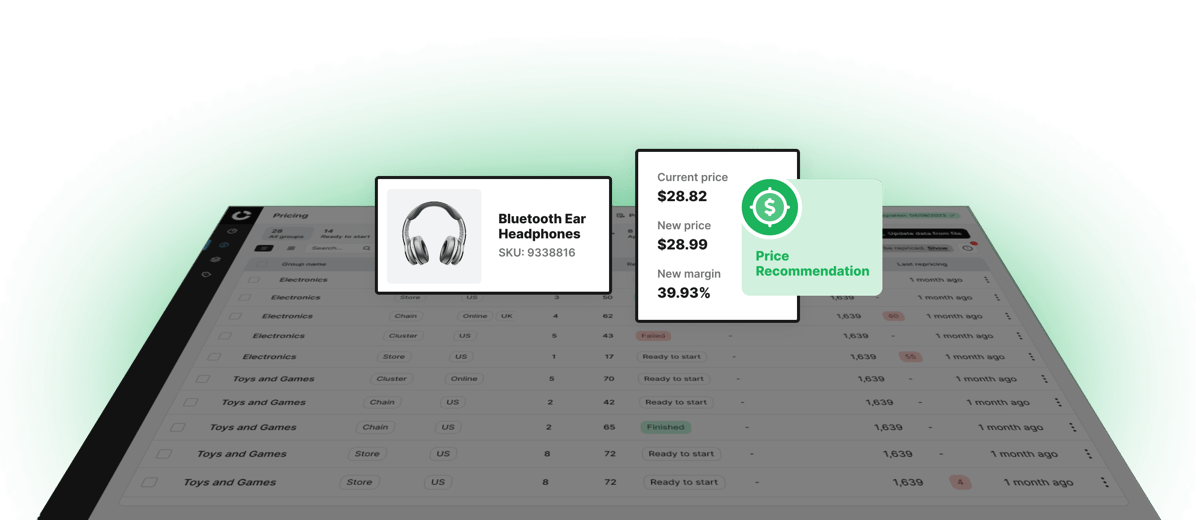




A price optimization strategy is a structured approach to setting prices for every product in a retailer’s assortment. Instead of relying on reactive repricing, enterprise retailers with vast SKU counts and omnichannel operations use this strategy to proactively manage assortments, respond to customer behavior, and protect their bottom line.
This guide explains what a price optimization strategy looks like in practice, how to build one, and which models and tools enable it to work at scale.
What is price optimization?
Price optimization is a data-driven process for finding a price point that best balances revenue, margin, and customer demand across individual products and categories.
You can develop a general pricing strategy based on your positioning, such as whether you’re a value retailer or premium brand. Retail price optimization, on the other hand, determines the specific price points that will perform best given current market conditions.
For retailers, price optimization extends across three distinct scenarios:
- Starting prices for new or restocked products, where demand signals are thin and getting the opening price right sets customer price perception.
- Promotional and markdown prices, where discount depth needs to be calibrated against actual demand.
- Ongoing prices for the core assortment, where incremental changes compound into significant margin outcomes over time.
Why retail price optimization strategy is different from general pricing
Retail price optimization is different due to the sheer number of moving parts involved in retail, including products, channels, customer segments, and competitors. General pricing assumes a relatively stable environment with manageable variables. Retail adds scale, speed, and interdependency, each compounding the others.
Four factors in particular separate retail price optimization from general pricing models:
1. Catalogue scale
Enterprise retailers manage tens of thousands of SKUs across multiple categories and price zones. Each SKU carries its own demand profile and margin structure. General pricing cannot sustain this level of complexity.
Effective price optimization for retail requires automation that factors in each product's role in the portfolio before making a recommendation, not just matching a competitor's listed price.
2. Cross-product demand relationships
Retail demand is interconnected. A discount on a leading national brand may increase demand while reducing sales of an own-brand alternative. Similarly, pricing changes within a product family often affect adjacent variants and bundle purchases.
These relationships are invisible to SKU-level pricing tools. Retailers are increasingly leaning on demand forecasting to model how demand distributes across product groups, instead of evaluating products in isolation.
3. Omnichannel complexity
Retail pricing spans numerous channels, each with different customer behavior and competitive pressure. Customers of online stores, physical locations, and marketplaces do not respond to price changes in the same way.
Retailers managing cross-channel pricing must align decisions across all channels without affecting conversion rates. Some rely on KVI pricing to set competitive prices for high-traffic products, while protecting margins on price-insensitive items that customers rarely visit.
4. Speed of competitor repricing
Competitor pricing changes frequently in many retail sectors, especially grocery, electronics, and fashion. A retailer relying on weekly competitor data or manual review cycles is working with outdated information.
To keep up, competitive pricing analysis must be near real-time and directly connect to the repricing workflow for effective price optimization for retail.
The core process of how a retail price optimization strategy works
A retail price optimization strategy functions as a continuous loop. It connects objectives, data, modeling, execution, and feedback into a single system. Each step feeds the next, creating a structured cycle rather than a linear workflow.
Step 1: Define pricing goals by product segment
Pricing goals differ across product categories because each group plays a different role in revenue generation and customer behavior. Effective pricing starts with clarity on what each product segment needs to achieve.
Common segment goals include:
- Safeguarding price perception and competitive standing with KVIs and high-value items.
- Protecting or recovering profit margin with premium or long-tail products.
- Clearing stock and moving inventory for sitting inventory.
Step 2: Collect and clean up data inputs
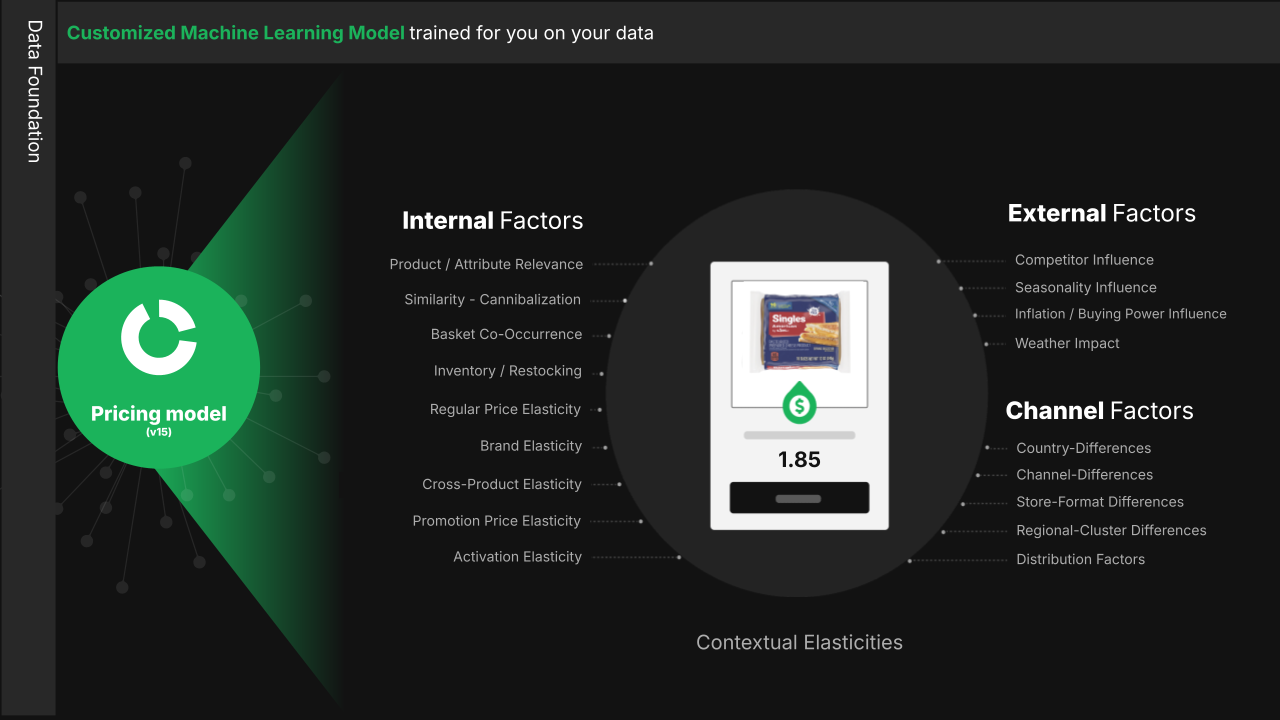
Price optimization for retail depends on structured data from multiple internal and external sources. Core inputs are:
- Sales and revenue history of at least two years.
- Current inventory levels and stock pressure.
- Promotional history and discount calendars.
- Live competitor prices with high match accuracy.
Source: Competera Pricing Platform
Step 3: Model demand elasticity at SKU and category level
Price elasticity of demand measures how customer demand responds to price changes across products and categories. It helps you identify:
- Price sensitivity at SKU level.
- Category-level response patterns.
- Price thresholds where increases don’t reduce demand.
Modern retail price optimization strategies increasingly rely on full demand elasticity modeling, combined with machine learning, to understand how these variables interact and guide pricing decisions.
Step 4: Run pricing simulations before executing changes
Platforms like Competera allow teams to run simultaneous pricing simulations and compare revenue and margin outcomes before executing changes. Typical simulation outputs include:
- Revenue impact across scenarios.
- Margin shifts by SKU and category.
- Demand distribution across substitutes.
Step 5: Execute with rules, guardrails, and human oversight
Execution requires controlled boundaries to prevent pricing instability. Retailers apply constraints like:
- Minimum margin thresholds.
- Maximum price gaps between channels.
- Brand positioning requirements.
- Maximum discount limits.
While these rules can be set and automated within platforms like Competera, human oversight remains essential. Pricing teams define constraints and commercial priorities, while algorithms evaluate scenarios and generate recommendations.
Step 6: Measure outcomes and close the feedback loop
Retail price optimization can continuously improve with consistent outcome measurement. Measurement frameworks rely on:
- Revenue changes by SKU and category.
- Margin stability across product lines.
- Sell-through rates of products with price changes.
- Price positioning against competitors.
These outcomes are tracked through pricing metrics that capture how pricing decisions translate into measurable commercial results.
Meanwhile, pricing KPIs feed back into the next optimization cycle by translating those results into performance benchmarks used for ongoing pricing decisions.
Types of price optimization strategies
A good price optimization strategy should strike a balance between product role, category dynamics, customer perceived value, and competitive context. Understanding each strategy and where it breaks down is what allows pricing teams to build a strategy that holds up across categories and market conditions.
Cost-based pricing optimization
Cost-based pricing optimization sets prices by adding together procurement costs and target margins. It's the most straightforward approach and often the starting point for retailers building a pricing framework.
However, it doesn’t consider demand variation across SKUs or market signals, such as seasonal demand surges or competitors running promotions. Cost-based pricing works best as a floor that protects a minimum margin, but not for finding the right price.
Demand-based pricing optimization
This is a price optimization strategy that adjusts prices according to customer response patterns and their willingness to pay. Retailers identify where demand is price-sensitive and where it isn’t with demand forecasting and price elasticity modeling.
This approach is particularly effective for long-tail products that sit outside competitive visibility, where a retailer has room to recover margin without risking traffic.
Competitor-based pricing optimization
Competitor-based pricing leverages live market data to adjust prices in line with competitors. It's the most widely used approach in retail, but also the most easily misapplied. Following competitors on every SKU could lead to margin compression without competitive advantage.
Success for this price optimization strategy requires competitive data that moves as quickly as the market. Competera Competitive Intelligence Data tracks prices across 34 markets, refreshing every 15 minutes, so pricing teams respond to meaningful shifts, instead of irrelevant noise.
Value-based pricing optimization
Value-based pricing optimizes prices based on perceived value by customers, rather than cost or competitive positioning.
This price optimization strategy protects margin on own-brand and exclusive products without direct competitor reference points. Retailers who use AI models can get a clear read on true willingness to pay by analyzing basket dynamics and purchase patterns.
Portfolio pricing optimization
Portfolio pricing optimization considers relationships across a retailer’s full assortment. It accounts for cross-product demand relationships and optimizes at the category and portfolio level.
It’s part of dynamic pricing optimization, where optimal pricing is identified and set in near real time to maximize profit or revenue for the business, based on demand across portfolios.
Promotional pricing optimization
This retail price optimization strategy determines the right discount depth for specific products, driven by campaigns, seasonality, or clearance cycles. It requires careful coordination to avoid long-term margin erosion.
Accurate demand forecasting is what separates effective promotions from expensive ones. Without data on demand, retailers may over-discount products that would have sold anyway and under-invest in promotions that would have moved the needle.
Combining price optimization strategies: the competitive and value-based framework
Effective retail pricing combines strategies rather than applying a single strategy across the entire assortment. Each product segment has a different role in the portfolio — some drive traffic while some protect margin — and the pricing logic assigned to each should reflect that role directly.
The competitive and value-based combination is one of the most common frameworks at enterprise scale. For example:
- KVIs and high-visibility categories get competitor-based pricing, anchored by real-time market data.
- Own-brand and exclusive products get value-based pricing, anchored by customer behavior and basket analysis.
- The two approaches work in parallel, where one protects competitive standing and the other recovers margin.
This is the framework that Competera AI-Driven Retail Pricing Software is built to support. It’s a configurable framework that assigns the right model to each product segment and adapts as market conditions shift.
Pricing optimization models and methodologies
Pricing models translate raw data into structured pricing decisions. Selecting the right model depends on data precision and operational readiness.
Rule-based pricing model
A rule-based pricing model executes price changes based on predefined pricing rules, like margin floors and discount limits. Pricing rules are fast to deploy, easy for teams to understand, and predictable in their behavior.
However, it’s limited in its rigidity. When you’re managing products, categories, and channels at the same time, rule-based price optimization for retail can't adapt to demand shifts or seasonal changes.
Statistical and regression-based pricing models
A statistical model forecasts overall optimal prices and demand response based on historical sales data. A regression model drills deeper to isolate the exact shift in demand caused by a specific price change.
They help identify relationships between price changes and sales at SKU or category level. The setback is that these models treat each SKU independently, failing to account for seasonality or cross-product demand relationships.
Machine learning and AI-driven pricing optimization
Machine learning and AI-driven pricing optimization processes and models multiple variables at once, including seasonality and competitor signals. They can adapt continuously with new data, and identify patterns and effects that regression models miss.
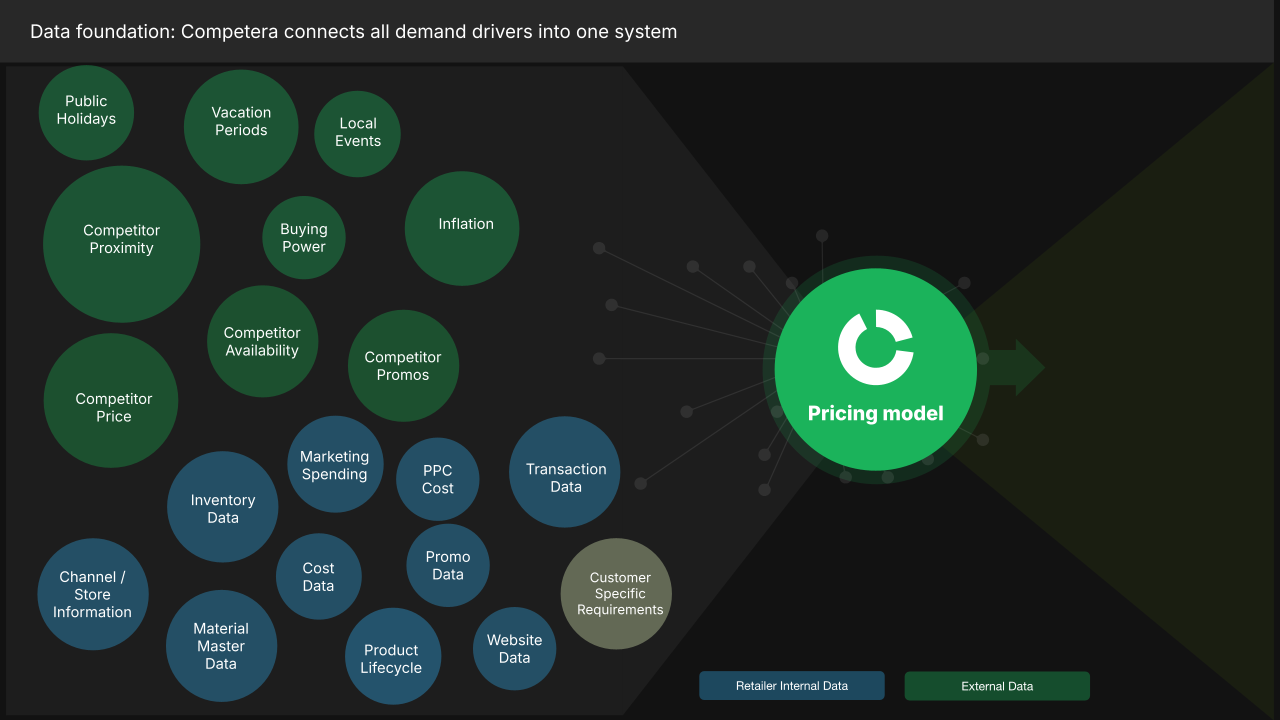
For example, Competera contextual AI weighs over 20 demand-influencing factors, like basket dynamics, brand perception, and inflation, to produce pricing recommendations.
 Source: Competera Pricing Platform
Hybrid models
Hybrid models combine rules, statistical methods, and AI outputs to enforce constraints and provide recommendations. This structure is common in enterprise retail environments where control and adaptability must coexist.
How to choose the right price optimization model for your retail maturity
Choosing the right pricing optimization model comes down to organizational readiness:
- Retailers in the early stage of their pricing journey should start with a rule-based model for control.
- Retailers at the middle stage can add statistical and regression models on top of it for price elasticity insights.
- Retailers managing hundreds of thousands of SKUs across channels and regions tend to adopt AI-driven models, as business complexity exceeds what rule-based or statistical and regression approaches can handle.
When to use rules vs. when to trust the algorithm
Rules are the right tool when pricing logic is stable and financial constraints dominate decision-making. Algorithms perform better when demand shifts frequently across SKUs, categories, and channels.
Rules also work well as a safety layer on top of AI recommendations, setting hard floors and ceilings within which the algorithm operates. Most retail systems combine both layers rather than choosing one.
Examples of retail price optimization in practice
Pricing strategy looks different depending on the retail vertical, because demand drivers vary. These three scenarios illustrate how a price optimization strategy plays out in practice:
Grocery retail: KVI optimization under competitive pressure
Grocery retailers protect margin and competitive standing by identifying KVIs and pricing only those aggressively. The challenge is that most retailers either over-invest in defending products that customers aren't comparing or under-invest in items that shape price perception.
By combining KVI pricing strategy with a platform like Competera Retail Competitive Intelligence Data, retailers can identify KVIs through analysis of purchase frequency and market data. These items get competitor-anchored prices that are updated as competitors reprice.
Consumer electronics retail: lifestyle optimization across SKUs
Consumer electronics pricing follows a lifecycle, where early adopters pay full price, while markdowns occur only as newer models arrive. Retailers who don’t optimize prices at each stage may leave excess inventory at a product’s end-of-life.
A lifecycle-based approach automatically assigns each product to a pricing campaign that reflects its current stage. A dynamic pricing strategy makes this possible at scale, giving each product the right pricing logic for where it sits in its lifecycle, rather than where it was six months ago.
Health and beauty retail: own-brand margin optimization
Own-brand health and beauty products lack direct competitors, which makes cost-based optimization the default, but it’s not always the right choice. A fixed markup could leave margin on the table if customer willingness to pay exceeds the set price.
To maximize profit margin and revenue, retailers should leverage tools like Competera to analyze basket behavior, such as how price changes on branded products impact demand for own-brand items, allowing them to set optimal prices without sacrificing sales or margin.
What to look for in a retail price optimization software
An ideal retail price optimization software should be able to model demand and generate recommendations that teams act on with confidence, while integrating into existing workflows with minimal disruption.
When evaluating platforms, these are the key capabilities you should look out for:
- Demand modeling depth: The retail price optimization software should be able to model demand at portfolio, category, channel, and SKU levels.
- Simulation before execution: It’s a must for software to be able to run pricing simulations, and see projected margins and sell-through impact before a price goes live.
- Transparency and explainability: Pricing teams should be able to see the factors behind every recommendation and understand why it was generated.
- Competitive data quality: Look for dedicated competitive data infrastructure, high match accuracy, and fast refresh rates.
- Integration speed: Enterprise retailers need a system that connects to existing ERP, PIM, and commerce platforms without a multi-year implementation.
- Human-in-the-loop design: The platform should support human oversight, as pricing teams need to retain control over final decisions, especially during promotions and peak seasons.
Competera Pricing Platform unifies all these capabilities in a single system. Our contextual AI evaluates 20 demand-impacting factors simultaneously, generating recommendations with 95% forecast accuracy. Combined with Competitive Intelligence Data, retailers gain real-time market visibility and pricing recommendations, while retaining full control over pricing decisions.
Contact us to see how Competera helps retailers build and refine price optimization strategies across products, channels, and markets.

.png)