


TL;DR
- Price intelligence shows retailers where they are overpriced, underpriced, or already in a strong market position.
- Price intelligence software should track more than competitor prices. Promo data, stock availability, assortment updates, and other factors should also be considered.
- AI-driven competitive price intelligence helps retailers to effectively manage KVIs, compare pricing across geographies, launch new entries smartly, and manage markdown campaigns.
- Good price intelligence data depends on accurate product matching and frequent refreshes. A scraped price with the wrong product match is worse than no data at all.
- The most useful price intelligence solutions feed competitive data directly into pricing workflows, so teams can act on market changes without moving data between multiple systems.
What is price intelligence?
In its essence, price intelligence implies collecting competitor pricing, checking that the data is accurate, and combining it with the market signals that explain what’s really happening.
But it’s not enough to know what is price intelligence. What if your competitor drops the price of a top-selling product by 10% overnight. The price change is obvious. The reason behind it usually isn’t.
There could be different explanations from a short promo campaign to excess inventory or simply a marketplace seller trying to win the Buy Box. Pricing teams need that context before deciding whether to respond.
Price intelligence vs. competitive intelligence
The two concepts overlap, but they answer different business questions.
If your team wants to know whether a competitor has changed the price of a product, launched a promotion, or gone out of stock, you're looking at competitive price intelligence. The focus is pricing and the market signals directly tied to it.
In contrast, competitor price intelligence not only deals with pricing itself, but also covers a wide range of other factors. These may include assortment specifications, marketing info, customer data, brand positioning or other inputs.
Why price intelligence matters for enterprise retailers
Many retailers already understand why competitive pricing matters. The challenge is scale.
When dealing with large portfolios across diverse geographies and markets, price intelligence solutions make a measurable difference. By automating data collection and continuously monitoring the market, they free pricing teams to focus on pricing strategy instead of gathering information.
This is especially relevant for retailers moving beyond manual, market-driven pricing. Gartner describes these organizations as progressing from Stage 2, where competitive data exists but is managed largely through manual processes, toward Stage 3, where pricing decisions become increasingly data-driven and scalable.
How price intelligence works
Mere data collection won’t help you much. To use data effectively, it should first be matched, validated, analyzed, and delivered in a format suitable for a pricing team.
Let’s take a look at how online retail price intelligence works step-by-step.
Step 1: Data collection
Data collection is where everything begins. But this is also where complexity comes in. Tech-savvy price scraping software is capable of automatically capturing price changes, promotions, availability, and assortment updates as often as the business requires. Some categories change once a day. Others change several times before lunch.
Step 2: Product matching
Finding competitor prices is one thing. Making sure you're comparing the right products is another.
One store may use the manufacturer's full product name, another a shortened title, and a marketplace seller may offer something completely different from both.
Fortunately, solutions, like Competera, can help deal with these kinds of challenges. Smart product matching functionality allows to accurately identify similar products so you can focus only on true competitors really worth following.
Step 3: AI-driven enrichment and analysis
Two retailers can show the same product at different prices for completely different reasons.
One may be running a weekend promotion. Another could be discounting slow-moving inventory or offering free shipping. Looking only at the price makes those situations impossible to tell apart.
This is why a price intelligence tool captures more than prices. It collects the surrounding market signals and uses AI to surface unusual changes, pricing patterns, and competitor activity that deserves a closer look. Instead of working through thousands of data points manually, analysts can focus on the handful of changes that can bring a genuine competitive advantage driven by competitor price intelligence.
Step 4: Validation and quality assurance
No competitive dataset is perfect the moment it's collected. Products get mismatched, prices change before the next refresh, and some records arrive incomplete. Validation and quality checks catch those issues before the data reaches pricing teams, making price intelligence data reliable enough for day-to-day pricing decisions.
Step 5: Delivery and integration
Competitive data only becomes useful when people can work with it.
Every pricing team works a little differently. Some review dashboards, others build around APIs, while many depend on scheduled reports or direct integrations. A price intelligence solution should adapt to those workflows instead of requiring teams to export, copy, and reconcile data across multiple tools.
Why do competitor prices alone not tell the full story?
Seeing a competitor sell the same product for less doesn't necessarily mean your own price is wrong.
Maybe they're running a two-day promotion. Maybe they're trying to clear inventory before new stock arrives. It could even be a marketplace seller with a completely different pricing strategy. Looking at the number alone doesn't answer any of those questions, nor does it help to gain a competitive advantage.
That's why competitive price intelligence includes much more than prices. It combines them with promotions, availability, seller information, and other market signals that explain what changed and whether it deserves a response. Competera's Competitive Data follows that approach, giving pricing teams the context they need rather than just another list of competitor prices.
What price intelligence data covers
Сompetitor's price is just one data point. On its own, it rarely explains what's happening in the market. Looking at prices alone often raises more questions than it answers. A price intelligence tool collects that surrounding market data, helping pricing teams understand what actually changed before deciding whether to respond.
This broader view is what makes retail price intelligence useful for decision-making instead of simple monitoring.
What enterprise retailers track
Most retailers monitor a similar set of market signals, although priorities vary by category and business model.
Typical price intelligence data includes:
- Competitor prices across channels and regions
- Promotions and discount activity
- Product availability and stock status
- Marketplace sellers and fulfillment options
- Product attributes and assortment changes
- Historical pricing trends
- Comparable and substitute products
Viewed together, these data points create a much richer picture of market behavior than price comparisons alone. They also form the foundation for effective competitive pricing analysis.
Key use cases for price intelligence in enterprise retail
The value of competitive price intelligence extends well beyond price monitoring. Retailers use it to support everyday pricing decisions as well as longer-term commercial strategy.
KVI pricing and competitive positioning
Price perception isn't evenly distributed across an assortment. A relatively small group of products has an outsized influence on how customers judge whether a retailer is expensive or competitively priced. These are the Key Value Items (KVIs).
Instead of monitoring every SKU with the same intensity, pricing teams often prioritize this group. Competitor price tracking helps them respond when those products move, while leaving more room to optimize margins elsewhere.
New market entry
One of the first questions when entering a new market is simple: What does "competitive pricing" actually look like here?
Entering a new market means pricing against competitors you've never priced against before. Local price levels, promotional activity, and category leaders often differ from what works elsewhere. Online retail price intelligence gives pricing teams a chance to understand that environment before launch, rather than adjusting after the market responds.
Feeding AI-driven pricing decisions
Competitive data becomes much more valuable once it is part of the pricing engine rather than a separate report.
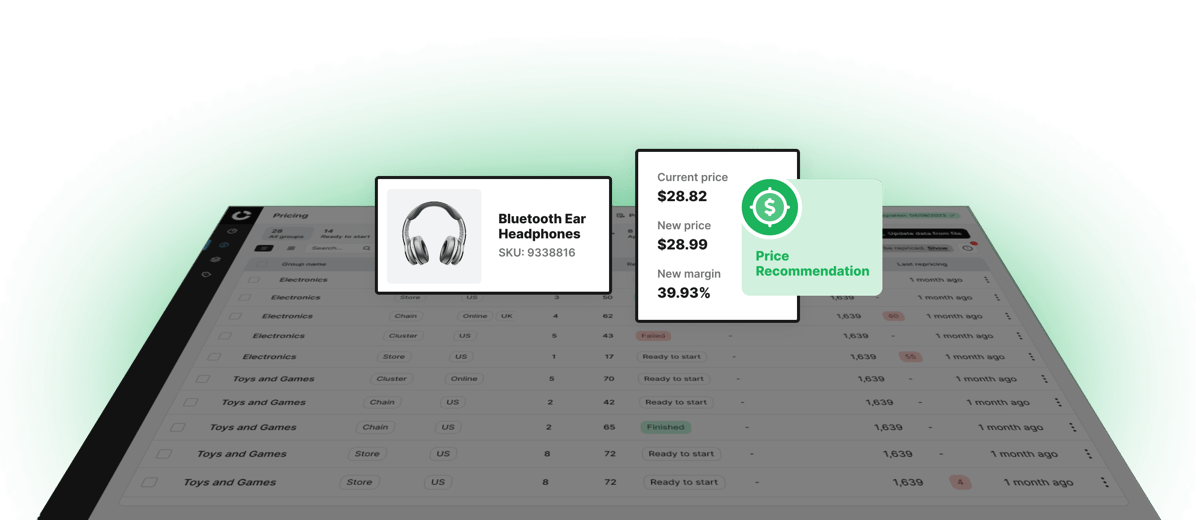
AI models evaluate competitor prices alongside demand signals, pricing rules, and commercial targets. Connecting these inputs, a pricing engine becomes able to generate pricing recommendations that are aligned with both the market and the retailer's goals.
To learn how competitive data supports automated pricing decisions, read our guide to dynamic pricing.

What to look for in a price intelligence platform
Every platform promises competitive pricing data. The difference lies in how accurate, complete, and actionable that data actually is.
For large retailers, five capabilities deserve close attention.
Data volume and geographic coverage
Monitoring a handful of competitors is relatively straightforward. Monitoring thousands of products across multiple countries is not.
The amount of price intelligence data a platform collects, together with its geographic coverage, determines whether it can support enterprise pricing at scale. Competera Competitive Data delivers 119 million data points every month across 34 markets, giving pricing teams a consistent view of their competitive landscape.
Match accuracy and SLA guarantees
Poor product matching leads to poor pricing decisions.
Data quality becomes visible when pricing teams start using the data. Incorrect matches or missing records quickly undermine trust. Competera Competitive Data addresses that challenge through AI-powered matching, human validation, and a 98% average data delivery SLA.
Refresh frequency and delivery speed
In some retail categories, prices change several times a day.
Weekly updates cannot keep pace with that reality. By the time analysts review the data, competitors may already have moved again. Competera Competitive Data supports unlimited monitoring frequency, allowing retailers to align refresh schedules with the dynamics of each category.
AI-assisted insights, not just raw data
Most pricing teams don't need more data. They need help deciding where to look first.
The built-in AI Assistant in Competera Competitive Data scans market activity, flags unusual pricing behavior, and answers business questions in plain language. Instead of combing through reports, analysts can start with the changes most likely to affect pricing decisions.
Integration with pricing execution
Competitive data should not live in isolation.
When pricing data sits in one application and pricing decisions happen somewhere else, analysts spend valuable time moving information between systems. An integrated price intelligence solution removes that disconnect by feeding competitive data directly into pricing execution.
Conclusion
Pricing teams don't make decisions based on prices alone. They look for patterns, verify changes, and weigh competitive moves against their own commercial goals.
Competera’s Competitive Data brings those inputs together in one place, combining competitive market data, product matching, and AI-assisted analysis to support pricing decisions across the enterprise.

References
-
Karki, H. (2025). Industry positioning: Create your ideal retail enterprise customer persona. Gartner.
-
McKinsey & Company. (n.d.). B2C Pricing Insights. Periscope by McKinsey
-
Simon, J., Bilstein, F., Kuehnle, H., & Tschiesner, A. (2015). Pricing in retail: Setting strategy. McKinsey & Company.
.webp)