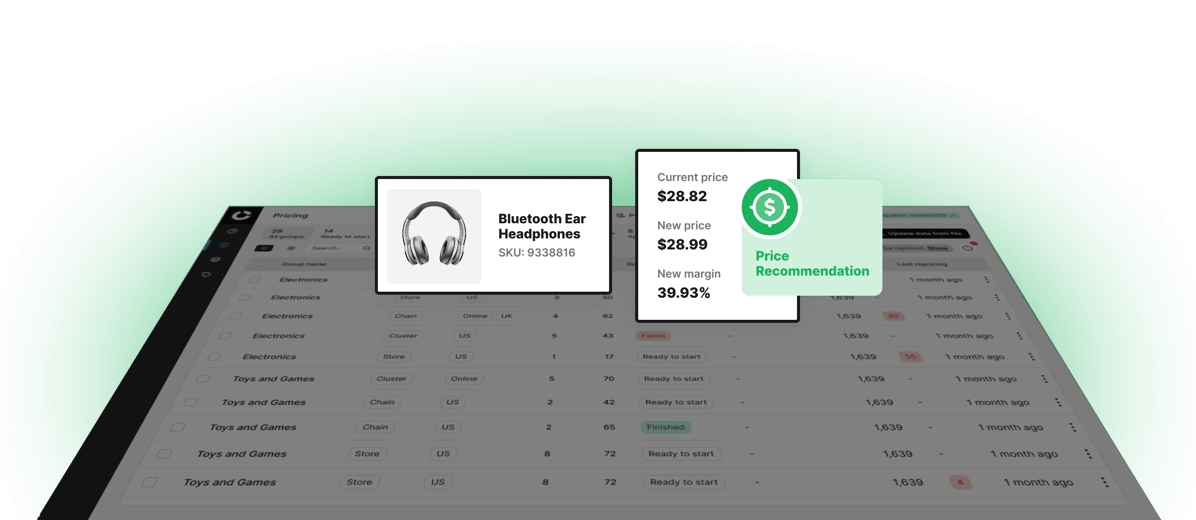




A pricing system is the combination of data, rules, models, and workflows a retailer uses to set and manage prices. Checking and reacting to competitor moves by hand works until a portfolio reaches a few hundred SKUs. Then it breaks, because modern retail moves too fast for spreadsheets.
This guide explains what a pricing system is, when a business needs one, which features matter for enterprise retail, and how to implement one step by step.
Key takeaways
- A pricing system brings competitor data, pricing rules, demand models, and team approvals into one workspace.
- Manual pricing breaks down as the catalog, regional markets, and sales channels multiply.
- Clean your internal product data, pilot a single category, prove the ROI, then scale. Launching everything on day one rarely works.
- Competera supports the whole journey, from rule-based repricing to AI optimization, on one platform and one data foundation.
What is a pricing system?
A pricing system is the operational machinery behind a retailer's price tags. It's where market data, margin rules, pricing models, and team approvals come together to produce prices across thousands of SKUs, channels, and stores.
A pricing system covers more than the software. It also includes the operational routine around it: which market signals matter, who signs off on price changes, and how the team evaluates whether a change paid off. Some retail teams run this through a web of linked spreadsheets. Others use rule engines or machine learning models that forecast how customers will respond to a price.
What a pricing system is not
A pricing system is different from a pricing strategy. Strategy is the commercial goal, such as positioning as the low-cost leader or protecting a 30% margin floor. The system is the engine that executes pricing strategies day in and day out.
A pricing system is also more than a price scraper. Collecting competitor prices is table stakes. A full pricing system also looks inward, factoring in stock levels, landed costs, and customer demand to decide whether matching a competitor's price drop makes financial sense.
The pricing system maturity spectrum
Pricing capabilities grow with data maturity. Moving a category team from basic tracking to deep-learning demand models overnight rarely works: it burns budget and frustrates the team. Retailers usually progress through a few recognized stages, although few move in a straight line.
When cost-based pricing stops working, retailers usually add competitor price monitoring. It solves the visibility problem but can tempt managers into reactive price matching that erodes gross margin. To regain control, they add rule-based automation: conditional logic, such as a hard 15% margin floor, keeps repricing fast and protected.
Mature teams then move to AI optimization, where models weigh price elasticity, stock health, and demand trends to find the optimal price within the rules the team sets. Buying the most complex tool on day one is a classic trap, though: advanced models underperform when historical data is inconsistent or integrations lag.
When does a business need a pricing system?
Manual pricing can work in the early stages of a business. A retailer needs a pricing system once catalog growth outpaces what the team can price accurately, pricing decisions start to lag, and recurring errors begin to cut into profitability.
Signals that a manual pricing process has reached its limit
Catalog growth breaks spreadsheets first. Once a retailer operates across multiple channels and countries, manual tracking stops being sustainable. The warning signs are usually clear:
- Competitors change prices faster than the team can react.
- Prices differ between the mobile app and the website because there's no unified pricing logic.
- Reactive price matching erodes net profit.
- Pricing managers spend most of their time gathering data and very little analyzing it.
At that point, moving to data-driven pricing replaces manual churn with clear visibility, faster execution, and protected margins.
Key features of a pricing system for enterprise retail
An enterprise pricing system needs to do much more than update prices quickly. Without reliable data, capable models, safety controls, and tight integration, it will fall short of what a large retail operation requires.
Competitive data coverage and accuracy
Bad data undermines everything downstream. If product matching is unreliable or competitor data arrives late, an automated pricing strategy ends up reacting to a market that doesn't exist. Enterprise retailers need broad catalog coverage, precise product matching, and refresh rates aligned with their repricing cycles across every channel they track.
Competera Competitive Data delivers more than 119 million data points each month across 34 markets, with up to 99% match accuracy and a 98% delivery SLA.
Pricing model sophistication
Static markups can't keep up with large, fast-moving assortments. At some point, retailers need models that weigh price elasticity, shifting demand, and inventory health together. The model should match the quality of the data: a complex machine learning engine adds little if historical records are a mess.
Learn how a dynamic pricing algorithm supports automated pricing decisions.
What-if simulation and scenario modeling
Price changes shouldn't go live blind. What-if simulation works as a sandbox where teams model the margin and volume impact of a change before customers see it. Scenarios also show how long a change is likely to take to reach its target, which helps teams set realistic pricing KPIs.
Explainability and transparency
Black-box recommendations meet instant pushback. When a system suggests a markdown, the pricing team needs to see the reasoning behind it, including the demand drivers and constraints that shaped the price, before they'll trust it.
Guardrails and human oversight controls
An algorithm without limits is a commercial risk. Clear pricing rules set hard margin floors, price ceilings, and approval triggers. Modern systems remove a lot of routine work from pricing managers, but people still set the strategy, respond to alerts, and check that the system behaves as intended.
Integration with existing retail tech stack
A pricing system stuck in a data silo adds little value. It needs to connect directly to ERP, POS, and e-commerce platforms, without manual CSV exchanges.
Channel and market coverage
Pricing across countries and digital touchpoints breaks rigid tools. A pricing system has to handle currencies, regional taxes, pricing zones, and channel-specific rules.
Time to value
Multi-year implementations kill momentum. Data volume matters less than data quality and relevance: a clean, well-structured data set is what makes a pricing system quick to integrate and fast to deliver ROI.
How to implement a pricing system: practical steps
Implementing a pricing system is a change management project as much as a technology one. It takes commitment from every stakeholder and a clear plan for each step.
Step 1: Define commercial objectives before selecting a system
Set your priorities before talking to vendors. If margin protection matters most, prioritize strong rule engines and guardrails. If you're chasing market share, prioritize fast, accurate competitor tracking. Clear targets make vendor selection much simpler.
Step 2: Audit existing data infrastructure
Answer honestly: how clean are your historical price records, and how well do your inventory databases connect to your sales channels? Fixing data gaps early keeps elasticity models from producing unreliable price points.
Step 3: Start with a defined scope and expand
A "big bang" rollout of pricing system software is a trap. Select a single store cluster or product category and use it as a testing ground. Once the team knows how the system works and the profit lift is proven, roll it out across the rest of the business.
Step 4: Align commercial and technology teams
A pricing system sits between the business and IT. Category leaders should own the pricing rules, while technology leads own the system connections. A clear division of responsibilities prevents internal debate once prices go live.
Step 5: Measure outcomes against defined KPIs
Hold the system accountable to the goals set in Step 1. Track metrics such as gross margin, revenue, and gross margin return on inventory investment (GMROI), and pay close attention to key value items (KVIs), since customers use those products to judge your price image. Learn more about KVI pricing.
Measure results against a control group of products or stores that weren't repriced. It's the most reliable way to separate the system's impact from wider market shifts.
How Competera works as a pricing system for enterprise retail
Competera supports every stage of the pricing journey on one platform and one data foundation, so retailers can move from competitor monitoring to demand-led optimization without switching vendors or rebuilding their data. The approach follows a simple principle: human guides, AI decides.
Competitive Data: the market intelligence layer
Pricing models are only as good as the data behind them. Competera Competitive Data delivers SLA-controlled price monitoring across large catalogs, digital channels, and local markets, with up to 99% match accuracy and a 98% delivery SLA. It gives commercial teams reliable market intelligence from day one, and it doesn't require years of clean historical data to start.
Adaptive AI: the price-led optimization layer
Adaptive AI, the price-led package of the Competera Pricing Platform, uses a statistical price-elasticity engine that needs just three months of sales history. Teams combine business rules, margin floors, and competitive constraints in a no-code rule builder, and an AI agent resolves rule conflicts automatically.
Contextual AI: the demand optimization layer
Simple scripts only look at cost-plus math. Contextual AI, the demand-led package of the Pricing Platform, uses a contextual neural network that weighs more than 20 demand factors, including price elasticity, stock health, and product lifecycle stage. Trained on 24 months of historical data, it recommends the price that best meets the retailer's goal for every SKU, based on the full demand context.
Human oversight and guardrail controls
Automation works best inside clear limits. Competera keeps pricing automation within commercial boundaries the team defines: margin floors, price ceilings, and approval workflows. Routine optimization runs automatically while pricing managers stay in control of every decision.
Who Competera serves
Competera is built for mid-market and enterprise retailers managing complex assortments across channels and markets. Retailers can start with competitor monitoring, move to price-led optimization with Adaptive AI, and add Contextual AI's demand modeling when their data and strategy are ready.
Retailers using the Competera Pricing Platform report 3–7% revenue growth, a 2–5 percentage point margin improvement, and a 50–70% reduction in pricing team workload.
Conclusion
A software subscription won't fix a broken commercial strategy. With clear goals in place, though, the right pricing system stops manual updates from draining margin. Choose a system that handles today's data reality and leaves room to grow, instead of the machine learning pipeline you hope to build in three years.
Talk to an expert to see which Competera package fits your pricing needs today and how it scales with you.
FAQ
A pricing system is the combined stack of data, analytics, pricing rules, and workflows that lets a retail team set and manage prices in one place.
The main types of pricing systems are spreadsheets, which break as catalogs grow; competitor price monitoring tools; rule-based pricing engines that apply if/then logic and guardrails; and AI pricing systems that model price elasticity and demand to recommend optimal prices.
A pricing system continuously takes in pricing and non-pricing data, such as competitor prices, sales, costs, and stock levels. It checks current prices against business goals and pricing rules, then generates price recommendations wherever a better price point is available.
The main advantages of a pricing system are speed and control. It frees pricing managers from manual spreadsheet work, applies pricing logic consistently across channels, and protects profitability across the whole portfolio.
A pricing system magnifies data problems. Messy inventory data or poorly set guardrails produce bad prices quickly. Advanced predictive models also need setup effort and continuous human oversight.
A good retail pricing system should collect accurate, timely competitor data (or connect to a trusted data provider), model demand, offer What-if simulation, enforce guardrails, integrate with ERP and POS systems, scale across markets and channels, and deliver value quickly.
How long it takes to implement a pricing system depends mainly on data quality. Competitor price monitoring can be live within a couple of weeks. A full demand-led AI setup may take three to four months, depending on data quality and stakeholder readiness.
A pricing strategy defines price positioning, such as whether to defend margin or win market share. A pricing system is the technology and process that carries out that strategy on the shelf.